
The Report
The report “Social Enterprises in Ireland: A Baseline Data Collection Exercise” provides a comprehensive overview of the social enterprise sector in Ireland, including its size, economic impact, employment and volunteer participation, and governance structures.
The work was commissioned by the Department of Rural and Community Development (DRCD) and carried out by a consortium. Full details of the consortium can be found in the report.

Please read on to view some of the key findings of the report, download a copy and view a video of social enterprise at work!
Size and Distribution of Social Enterprises
- There are an estimated 4,335 social enterprises operating in Ireland, with a wide range of activities, including social care, environmental sustainability, community development, and education.
- Social enterprises are geographically dispersed throughout Ireland, with significant clusters in Dublin, Cork, and Galway.
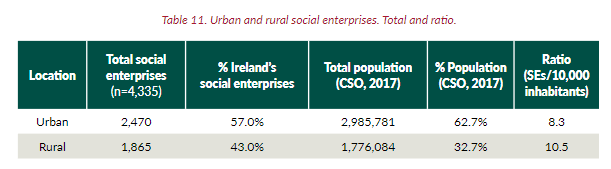
- There are approximately 8.5 social enterprises per 10,000 inhabitants. 57% of social enterprises are in urban areas (8.3 per 10,000 inhabitants) while 43% are in rural areas (10.5 per 10,000 inhabitants).
Economic Impact
- Social enterprises generate an estimated €2.34 billion in annual income, representing 0.63% of Ireland’s GDP.
- Social enterprises employ 84,382 people, (including full-time, part-time employees and contractors). This represents 3.7% of the total Irish workforce.
Employment and Volunteer Participation
- Social enterprises provide a significant source of employment for people with disabilities, migrants, and other marginalized groups.
- An estimated 74,825 volunteers participate in the social enterprise sector, including 30,324 board members.
- The age of the workforce is predominantly between 31 to 50. Women represent 69% of the workforce across the sector and 47% of the workforce is part-time.
- Labour Market Programmes are an important feature of the sector with 60% of those with paid staff employing people this way.
Governance Structures
- Social enterprises are governed by a variety of structures, including limited companies, charities, and community interest companies.
- Social enterprises are increasingly adopting more formal governance structures, such as limited companies, in order to access new sources of funding and grow their businesses.

Challenges and Opportunities
- Social enterprises face a number of challenges, including a lack of awareness and understanding of the sector, limited access to finance, and a shortage of skilled staff.
- Social enterprises also represent a significant opportunity to address social and environmental challenges, promote social inclusion, and create sustainable employment opportunities.
The report concludes by outlining a number of recommendations for policymakers, funders, and support organizations to further develop and support the social enterprise sector in Ireland. These recommendations include:
- Increasing awareness of the social enterprise sector
- Providing more funding opportunities for social enterprises
- Developing skills training and support for social enterprises
- Strengthening the regulatory framework for social enterprises
Overall, the report provides a valuable resource for understanding the social enterprise sector in Ireland and its potential to contribute to a more socially and economically sustainable society.
To access the full report please click here.
About Recycle IT
Recycle IT is a not-for-profit social enterprise providing collection and drop-off services for all types of waste electrical and electronic equipment (WEEE). Yearly Recycle IT offered to drop-off and collection services to thousands of homes and organizations across Dublin and surrounding areas collecting a range of WEEE which includes thousands of computers, televisions, toasters, cables, lawnmowers, monitors, microwaves and kettles.
Recycle IT services are provided in partnership with WEEE Ireland. Recycle IT is supported by South Dublin County Council and authorized by the National Waste Collection Permit Office and the local authorities across Leinster. Recycle IT receive funding thorough the Community Services Programme (CSP) operated by Pobal on behalf of the Department of Rural and Community Development (DRCD)
Watch the video below to learn more.
Visit our website for further details.
 Recycle IT