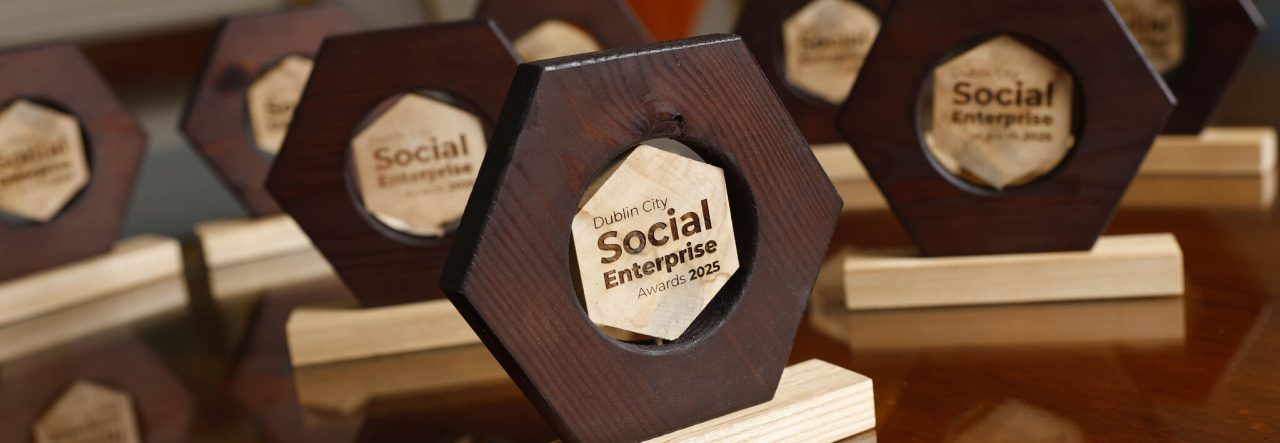
We’re absolutely delighted to share that Recycle IT has been selected as a finalist in the Repak Resource Awards 2026! 🎉♻️
Being recognized alongside organisations and initiatives that are driving Ireland’s circular economy forward is a fantastic achievement for our team — and one we’re incredibly proud of.
At Recycle IT, we believe that responsible recycling is about much more than simply collecting waste. It’s about recovering valuable resources, reducing environmental impact, supporting reuse, and keeping materials in the circular economy for as long as possible.
Repak Resource Awards 2026 – Finalist
Recognition
Every day, our team works hard to make responsible recycling more accessible, practical and impactful for businesses, organisations and communities in Dublin and surrounding areas. We’re passionate about giving unwanted electrical and electronic equipment a second life as something new – meaning materials can be responsibly recovered and recycled for reuse.
That’s why being named a finalist means so much to us. It recognizes not just what we do, but why we do it — to help create a more sustainable future and demonstrate that good environmental practices can deliver real, measurable value including the creation of training and employment opportunities to allow people to grow and develop.
Most importantly, this recognition belongs to our great team, our customers, partners and everyone who chooses to recycle responsibly. Your commitment helps make the circular economy a reality.
Repak Resource Awards 2026
A huge thank you to Repak and the Repak Resource Awards for recognizing the work being done across Ireland to improve resource efficiency, recycling and sustainability.
We’re proud to be finalists, proud of the work we do, and excited to celebrate alongside some of the organisations helping shape a more sustainable Ireland.
About Recycle IT
Recycle IT is anaward-winning social enterprise providing recycling collection and drop-off services for all types of waste electrical, electronic equipment (WEEE) and pure metal items.
Recycle IT services are provided in partnership with WEEE Ireland. Recycle IT is supported by the Department of Rural and Community Development, Dormant Accounts Fund, Pobal, South Dublin County Council and authorized by the National Waste Collection Permit Office and the local authorities across Leinster.
For further details about our free and cost-effective services call us on 01 4578321, email info@recycleit.ie or visit the Recycle IT website at www.recycleit.ie
Here’s to keeping resources in use, reducing waste and building a more circular future. 🌍♻️
♻️ Mattress Recycling Amnesty: South Dublin – Closed 🛏️
As the 2026 South Dublin County Council (SDCC) and Recycle IT Mattress Recycling Amnesty finished on Sept 26th 2026 we would like to say a huge thank you to everyone who has taken part over the past few months.
Mattress recycling delivers benefits far beyond waste reduction. It helps households dispose of unwanted mattresses responsibly, keeps bulky waste out of communities and landfill, and recovers valuable materials for reuse. It also supports local employment, creating meaningful work opportunities while building a more sustainable, circular economy for everyone.
Mattress Recycling with Recycle IT
Mattresses – Sustainable Waste
This amnesty was delivered with success through a partnership between several organisations It has provided residents with an opportunity to responsibly recycle over 1500 unwanted mattresses free of charge. This really supports sustainable waste management in our community resulting in mattress breakdown and component recovery for reuse through the work of South Dublin County Council, Recycle IT and Bounce Back Recycling.
The weekend of Saturday Sept 26th is the final opportunity to drop off your mattress free of charge under the amnesty. You can drop off free on Saturday 26th Sept at the car park of South Dublin County Council, County Hall, Belgard Square North, Tallaght, Dublin 24, D24 YNN5
Moving Forward
From Monday, the standard charge for mattresses dropped off directly to Recycle IT will apply: You can drop off between 8.30am and 4.15pm on Mondays – Thursdays and 8.30am and 3.15pm on Fridays. You will find contact detail here.
Recylce IT Collection Van
At present the standard drop off charge is €40.00 including VAT per mattress (any size)
If you require a mattress collection service in Dublin, an additional collection charge will apply.
Regrading a FREE mattress recycling amnesty in South Dublin for 2027, funding has to applied for and assigned to the initiative. We are usually made aware if it will go ahead, mid year so late June / July 2027.
We Appreciate Your Support
A big thank you once again to everyone who has recycled with us during the mattress amnesty 2026. Your participation has helped make a real difference and we appreciate your support in choosing responsible recycling with a social enterprise creating training and employment through sustainable recycling.
If you have any questions about mattress recycling or the services available from Monday onwards, please contact the Recycle IT team Monday–Friday on 01 457 8321.
♻️ Don’t miss the final weekend of free mattress recycling!
Thank you for helping us recycle responsibly. 🌍
Recycle IT Logo
About Recycle IT
Recycle IT is a not-for-profit social enterprise providing collection and drop-off services for all types of waste electrical and electronic equipment (WEEE). Yearly Recycle IT offered drop-off and collection services to thousands of homes and organisations across Dublin and surrounding areas collecting a range of WEEE which includes thousands of computers, televisions, toasters, cables, lawnmowers, monitors, microwaves and kettles.
Recycle IT services are provided in partnership with WEEE Ireland. Recycle IT is supported by South Dublin County Council and authorized by the National Waste Collection Permit Office and the local authorities across Leinster.
Ireland recycled a record 21.1 million electrical and electronic waste items in 2025, marking another significant increase in the country’s e-waste recycling efforts.
However, despite the record volume of electrical waste collected, Ireland still fell short of the European Union’s 65% e-waste collection target, according to new figures from WEEE Ireland.
The organisation’s latest annual report shows that almost 39,000 tonnes of e-waste were collected across Ireland during 2025 — equivalent to approximately 7,425 truckloads.
The number of items collected also increased substantially from 18.8 million in 2024.
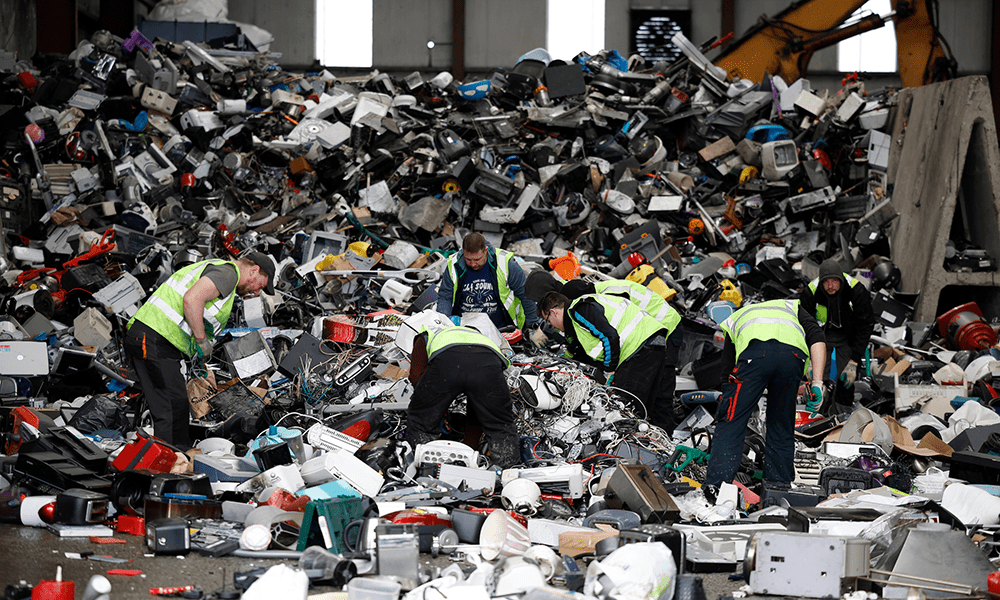
Electronic Recycling At Work
What Electrical Waste Was Recycled in Ireland?
Small electrical appliances accounted for the vast majority of items collected in 2025.
WEEE Ireland reported the recycling of:
18.5 million small appliances
1.9 million lighting products
278,222 TVs and monitors
123,060 fridge-freezers
The figures highlight the growing volume of electrical equipment being diverted from general waste and instead entering dedicated recycling systems.
Why Did Ireland Miss the EU E-Waste Collection Target?
Despite achieving record e-waste recycling volumes, Ireland remains below the EU’s 65% collection target.
WEEE Ireland says the issue is partly linked to how the target is calculated.
Under the current European system, a country’s e-waste collection rate is measured against the amount of electrical and electronic equipment placed on the market during the previous three years.
In 2025, Irish producers placed around 25kg of household electrical equipment per person on the market.
The system, WEEE Ireland argues, does not fully reflect the increasingly long lifespan of modern electrical products.
Many products can remain in use for considerably longer than three years before eventually becoming waste.
This is particularly relevant for newer technologies such as solar PV systems and heat pumps, which can remain operational for decades.
As a result, equipment sold today can influence future collection targets even though it may not enter the recycling system for many years.
E-Waste – Collected by Recycle IT
WEEE Ireland Calls for a Modern E-Waste Measurement System
Leo Donovan, CEO of WEEE Ireland, said Irish consumers are recycling more electrical waste than ever, but argued that the EU’s current measurement system was designed for a very different market.
He said current collection targets do not adequately account for modern consumption patterns, longer product lifespans or emerging technologies.
The comments come as the EU WEEE Directive is being re-evaluated, creating an opportunity to reconsider how national e-waste recycling performance is measured.
WEEE Ireland supports a more modern approach that better reflects how electrical products are purchased, used and eventually discarded.
Ireland Exceeds EU E-Waste Recovery Requirement
While Ireland did not meet the EU collection target, the latest figures show strong performance when it comes to recovering materials from collected e-waste.
An average of 82% of materials collected were recovered for reuse in manufacturing, exceeding the EU recovery requirement of 80%.
Meanwhile, 84% of counties increased their WEEE recycling rates year-on-year.
This suggests that the debate around e-waste should not focus solely on the quantity of waste collected.
How effectively valuable materials are recovered and returned to manufacturing is becoming an increasingly important measure of circular economy performance.
Battery Recycling in Ireland Continues to Grow
Ireland also achieved the EU’s 45% collection target for portable waste batteries, with WEEE Ireland collecting 1,284 tonnes during 2025.
Lithium battery collections have more than doubled over the past five years.
That increase reflects the growing number of products powered by rechargeable batteries, from consumer electronics to electric devices and other technologies.
Vape recycling is another emerging issue. More than 1.4 million vape devices were recycled through WEEE Ireland’s national takeback scheme in 2025.
Why Critical Raw Materials Matter
The growing volume of e-waste presents both an environmental challenge and an opportunity to recover valuable resources.
Electrical and electronic products contain critical raw materials including lithium, copper, cobalt and aluminium.
Recovering these materials through effective recycling can help reduce the need for virgin raw materials while supporting Europe’s ambitions to improve resource security and develop a more circular economy.
WEEE Ireland says the focus needs to move beyond simply collecting electrical waste.
The next stage is ensuring that valuable materials are recovered to high standards and kept within the manufacturing cycle for as long as possible.
How Can Consumers Recycle Electrical Waste in Ireland?
Consumers can play an important role in increasing Ireland’s e-waste recycling rate.
Old, broken or unwanted electrical items and waste batteries can be recycled free of charge through a number of collection routes, including:
Local authority civic amenity centres
Participating electrical retailers
WEEE Ireland collection events
Dedicated battery collection points
Electrical equipment should not be placed in general household waste where dedicated recycling facilities are available.
Ireland’s E-Waste Challenge Is Changing
Ireland’s record 21.1 million recycled electrical items in 2025 demonstrates that consumers are increasingly using dedicated e-waste recycling systems.
Heat Pump / Air Con – Photo by alpha innotec on Pexels.com
Yet the country’s failure to meet the EU collection target raises questions about whether the current measurement system accurately reflects the modern electrical goods market.
With products such as heat pumps, solar PV systems, rechargeable batteries and other technologies becoming increasingly common — and often remaining in service for many years — the way Europe measures e-waste recycling may need to evolve.
The future of Ireland’s e-waste strategy is therefore likely to involve more than simply collecting greater quantities of discarded electrical equipment.
It will also depend on recovering more valuable materials, improving recycling quality and keeping critical resources within the circular economy.
Ireland may have missed the EU’s collection target in 2025, but the record volume of electrical waste recycled shows that significant progress is being made.
Recycle IT is anaward-winning social enterprise providing recycling collection and drop-off services for all types of waste electrical, electronic equipment (WEEE) and pure metal items.
Recycle IT services are provided in partnership with WEEE Ireland. Recycle IT is supported by the Department of Rural and Community Development, Dormant Accounts Fund, Pobal, South Dublin County Council and authorized by the National Waste Collection Permit Office and the local authorities across Leinster.
For further details about our free and cost-effective services call us on 01 4578321, email info@recycleit.ie or visit the Recycle IT website at www.recycleit.ie
Replacing an old mattress often leaves householders with one important question – what do I do with the old one? From early August through to late September 2026, that question has a simple answer.
Mattresses for Recycling in the Community
Recycle IT, in partnership with South Dublin County Council (SDCC), is delighted to launch a Free Household Mattress Recycling Amnesty, giving residents the opportunity to recycle unwanted household mattresses responsibly and completely free of charge.
The initiative aims to make household mattress recycling more accessible while reducing waste, supporting the circular economy and helping to keep communities across South Dublin clean and free from illegal dumping.
Free Mattress Recycling Drop-Off at Recycle IT
Throughout the amnesty period, householders can bring unwanted mattresses directly to the Recycle IT recycling facility in Clondalkin, where they will be accepted free of charge.
Every mattress received will enter an authorised recycling process where valuable materials such as steel springs, timber, foam, textiles and fibres are separated and recovered for reuse wherever possible. This helps divert bulky waste from landfill while ensuring recyclable materials remain in productive use. Recycle IT operates as a not-for-profit social enterprise in cooperation with South Dublin County Council and other recycling partners to deliver environmental and community benefits.
Directions to Recycle IT
Directions to Recycle IT Recycling Centre:
The recycling facility is located at: Unit 14/2 Crag Terrace, Clondalkin Industrial Estate, Dublin D22 TK37
Recycle IT will be open between 9.30am – 3pm, Monday to Friday for mattress drop from Tuesday, August 4th to Friday September 25th, 2026
Call us on 01 4578321
Community Mattress Collection Events
Recognizing that not everyone can transport a mattress to the recycling centre, Recycle IT and South Dublin County Council will also organise a series of Community Mattress Collection Days throughout the amnesty period.
Mattress Recycling Community Events – Click to Enlarge
These local collection events will take place at authorised drop-off locations across South Dublin, making recycling even easier for residents.
Instead of travelling to Clondalkin, householders will be able to bring their old mattresses to designated community collection points closer to home.
These community events demonstrate how local partnerships can deliver practical environmental solutions while making recycling more convenient for everyone.
Why Recycle a Mattress?
Many people don’t realise that a mattress contains several recyclable materials.
These include:
Steel springs
Timber
Foam
Cotton
Polyester fibres
Fabric coverings
When processed correctly, these materials can be recovered and reused in manufacturing new products.
Without recycling, bulky mattresses occupy valuable landfill space for many years while wasting materials that still have significant value.
The Mattress Recycling Amnesty supports Ireland’s move towards a more circular economy, where products and materials are kept in use for as long as possible.
Instead of disposing of useful resources, recycling allows valuable components to be recovered and used again.
This reduces demand for new raw materials, lowers manufacturing impacts and supports more sustainable production.
Every mattress recycled contributes to reducing waste while improving resource efficiency.
Environmental Benefits
Recycling a mattress may seem like a small action, but collectively it makes a significant difference.
The benefits include:
Reducing bulky waste entering landfill.
Recovering valuable recyclable materials.
Conserving natural resources.
Lowering greenhouse gas emissions associated with manufacturing new materials.
Supporting sustainable waste management.
Helping keep neighbourhoods cleaner.
When thousands of householders recycle rather than dispose of mattresses, the environmental impact is substantial.
Benefits for Householders
The Mattress Recycling Amnesty has been designed to make responsible recycling as easy as possible.
Householders will benefit from:
Free mattress recycling throughout the campaign.
Convenient drop-off at the Recycle IT facility.
Additional community collection locations across South Dublin.
Confidence that mattresses are recycled through authorised facilities.
An easy alternative to costly disposal services.
Cost effective personal collection service. (No access to transport / very large mattress / multiple mattress for collection from a home.
Many people store unwanted mattresses for months because they are unsure how to dispose of them responsibly.
This initiative removes that barrier and provides a simple solution.
Working Together for Cleaner Communities
Illegal dumping of mattresses continues to affect many communities throughout Ireland.
Dumped mattresses spoil neighbourhoods, damage green spaces, attract additional waste and increase clean-up costs.
The partnership between Recycle IT and South Dublin County Council aims to encourage responsible disposal by making recycling easy, accessible and free.
By providing both central and community-based collection options, the initiative helps remove barriers that can sometimes lead to illegal dumping while encouraging greater public participation in recycling. Recycle IT has a long-standing relationship with South Dublin County Council in delivering community recycling initiatives and environmental awareness programmes.
Everyone Can Make a Difference
If you have an unwanted mattress in your home, garage, attic or spare room, now is the perfect opportunity to recycle it responsibly.
From Tuesday, August 4th until Friday September 25th, 2026, simply bring your mattress to the Recycle IT recycling centre free of charge or visit one of the authorised community collection events taking place across South Dublin.
Together, Recycle IT, South Dublin County Council and local residents can recover valuable materials, reduce landfill waste, discourage illegal dumping and create cleaner, greener communities for future generations.
For directions to the recycling facility and updates on community collection dates see below
Recycle IT will be open for free drop off between 9.30am and 3pm on Mondays – Friday. (Recycle IT don’t open on Bank Holidays).
You will find telephone, map and address details here
For generations in Ireland and across Europe thriftwas one of the main reasons for reuse. In the developing world, it’s still the case and leads to very high levels of reuse. In Ireland as in other developed countries rising wages and greater consumer purchasing power have increased the demand for convenience products.
Some people are still careful about how much money they spend and on what items. Reusing is a feature of their life so as not to waste money. We all could learn something from careful management of our resources whether at home or in the office.
A cheerful Reuse Scarecrow on a sunny day
Convenience products have helped us undervalue reuse in favor of disposal or recycling. Recycling is positive and has great benefits but uses resources including time, human capital and natural resources (e.g. fuel) to get the items to locations where they can be recycled effectively. Reuse is preferable!
If you can reuse an item yourself, it can help save money, save time, and the environment. Reuse helps reduce CO2 emissions and the mining of new raw materials. Reuse can be a matter of thinking a little differently and figuring out how old milk cartons, cans, bags, bicycles, tires, packing or wood may be reused to match your needs. Reuse will truly find a new life for items around your home or workplace.
Reverse the Trend with Reuse
51 Tips
We’ve listed some reuse tips for summer – Have a read and see what you can do, share with others and do involve any kids in your life.
Here are 51 short and simple reuse tips which are seasonal, creative, and encourages reuse in the garden, at the beach, on picnics, and around the home during the summer months.
Turn glass jars into iced coffee cups.
Make a herb garden from old tins.
Use old towels as beach picnic blankets.
Turn worn t-shirts into reusable shopping bags.
Reuse takeaway tubs for picnic food.
Store seashell collections in glass jars.
Make bird feeders from plastic bottles.
Use egg cartons to grow salad seedlings.
Turn wine corks into plant labels.
Reuse yoghurt pots for kids’ painting.
Make fairy lights from clean jam jars.
Repurpose old buckets as garden planters.
Store garden twine in coffee tins.
Use cereal boxes to organise holiday photos.
Turn old jeans into gardening aprons.
Save gift bags for summer birthdays.
Make a bug hotel from scrap wood and bamboo.
Reuse shoeboxes to store flip-flops.
Turn old mugs into succulent pots.
Keep rubber bands for sealing food bags.
Make colorful bunting from fabric scraps.
Reuse paper bags to wrap homemade gifts.
Turn old drawers into raised planters.
Use old toothbrushes to clean sandals.
Refill water bottles before every outing.
Decorate tin cans as flower vases.
Turn old blankets into outdoor cinema rugs.
Reuse bread bags for freezer storage.
Make wind chimes from old cutlery.
Store pegs in reused ice cream tubs.
Use cardboard boxes to build play forts.
Turn old scarves into picnic table runners.
Save jars for homemade lemonade.
Reuse ribbons to tie garden plants.
Make plant markers from ice lolly sticks.
Turn old CDs into garden bird scarers.
Reuse plastic trays to catch plant drips.
Store beach toys in old mesh bags.
Turn paper rolls into seedling pots.
Use old baskets for garden harvesting.
Make coasters from leftover tiles or corks.
Reuse envelopes for shopping lists.
Turn old socks into dusting mitts.
Save shipping boxes for moving or storage.
Make a scarecrow from worn clothing.
Turn broken crayons into colorful art shapes.
Reuse glass bottles as garden edging.
Make outdoor games from cardboard.
Repurpose old ladders as plant displays.
Turn fabric offcuts into reusable gift wrap.
Share or swap unwanted summer items with neighbors.
Soft Plastics – Recycling for Reuse
Soft plastics, along with rigid plastics, paper and card, tins and cans are now accepted in your household recycle bin. Soft plastics like plastic film (wraps, bags, etc.) are now accepted in the household recycling bin. This change is due to advancements in recycling technology and the opening of new markets for processing these materials. To ensure proper recycling, make sure the soft plastics are clean, dry, and loose when placed in the bin. Watch this short video
Waste is a treasure!
We all know one person’s waste is another person’s treasure. Instead of discarding unwanted tools, clothes, furniture or electrical appliances, try reuse with friends or donating them can reduce waste and help others save money.
Outdoor Reuse of Space
Local community groups, charity shops, schools, and nonprofit organizations may accept a variety of donated items, including used books, paint, working toys, and unneeded furniture. Please click here to learn more
About Recycle IT
Recycle IT, is an award-winning social enterprise offering electrical, electronic and metal recycling services through drop off and collection. Recycling services are provided in partnership with WEEE Ireland and South Dublin County Council.
Recycle IT is supported by Pobal and Dormant Accounts and authorised by the National Waste Collection Permit Office and the local authorities across the east midlands waste region.
Our goal is to create training and employment opportunities through the provision of waste management services. Surplus earned income is reinvested in operational, and employment-related costs.
According to Transparency Market Research the global photocopier market was valued at US$ 727.2 million in 2023. The market is projected to reach US $1.2 billion by 2034 through the increasing demand for multifunctional devices and the expansion serval end-use industries. People working from home and rising disposable income are other reasons for increased demand for smaller printers & copiers across the globe.
Some History
The photocopier has come a long way since the first model’s produced in the early 20th century with models found in homes and offices across the world!
In 1937 Chester Carlson, a patent attorney in New York invented a process called electrophotography. In 1938, this was renamed Xerography and the first known photocopied document was the “10-22-38 Astoria”.
The Xerography copying process went on to become one of the most well-known inventions of the 20th century and it’s estimated that Carlson gave away almost $100 million to charity and foundations before his death in 1968. Well done Chester.
Developments
In 1955, Haloid – by then Haloid Xerox – produced Copyflo, the first automated xerographic machine and many other companies followed Xerox into the market over the next 50 years.
Companies that manufacture photocopier cartridges and printers began offering recycling services in the early 1990s. Over the years many businesses developed photocopiers and cartridge recycling services as part of their customer sales, returning an environmental policy. It may take decades to figure out if these policies are good for the environment, but one thing we can say is it’s best to reduce, reuse and recycle!
Office Copier, Printer, Scanner – Recycle IT
Safety
Over the years photocopiers have developed into a computer with scanners and printers attached. As with other computers and servers, photocopies have a hard disk drive. This hard drive allows scans of documents and images to be stored on that drive.
As photocopiers and printers are replaced or upgraded the older model which has been in your office for years may have a hard disk drive filled with pages that have been copied over those years. Some of those pages will contain all sorts of business and personal information.
Think about what you or your office colleagues might have copied – bank account details, birth certificates, passports, tax forms – As old photocopiers are replaced think about any potential risks which the disposal of the old machine might create for your business and staff.
Office Photocopier – Recycle IT
Recycling
Today technology for printing and copying comes in a variety of sizes, from lightweight and budget-friendly printers to larger standalone multifunction machines. Printers, copiers, scanners, and fax machines are among the most common office equipment in work environments that need to be recycled.
When you dispose of your printer, please do so responsibly to ensure no toxic materials or e-waste go’s to landfills or is dumped in a remote location.
Recycle IT can remove large standalone photocopiers from office buildings and work spaces with lift access or no lifted access. Our trained team and specialised equipment can help clear old heavy equipment from second or third, floor buildings letting you take back the space. Just let us know the manufacturer name and model number of the photocopier or multi-function printer and we can check the specifications prior to removal.
If you need to safely and cost-effectively recycle copier and printing equipment, please call 01 4578321 or email Recycle IT.
Larger Photocopier and Stand
About Recycle IT
Recycle IT is an award-winning not-for-profit social enterprise providing a collection and drop-off service for all types of waste electrical, electronic and metal items. Recycle IT offer drop-off and collection services to both homes and organizations in Dublin and surrounding areas collecting a range of WEEE which includes thousands of printers and we can help recycle yours!
Our electrical community collection service is provided in partnership with WEEE Ireland. Recycle IT is supported by Pobal, South Dublin County Council and authorized by the National Waste Collection Permit Office and the local authorities across Leinster.
To speak with Recycle IT please call 01 4578321 or email us here
Recycling home appliances helps protect the environment, saves energy, reduces waste, and conserves valuable materials. It’s a smart, eco-friendly choice for everyone. Recent statistics show consumers recycled a record-breaking 41,730 tonnes of electronic and electrical waste in 2023 – the equivalent of almost 200 forty-foot containers more than the previous year, new figures reveal.
Tons of Electrical and Electronic Waste
Over 15 million small appliances such as coffee makers, calculators, kettles and keyboards, along with the equivalent of 66 million used AA batteries were also handed back for safe recycling to make their way into the circular economy.
Members of the public may dispose of all their old household waste electrical and electronic equipment (WEEE) free of charge at Recycle IT in Clondalkin, Co Dublin.
40 Foot Collection Trailer
Recycle IT are happy to say we have worked in partnership with WEEE Ireland for 20 year to help recycle appliances like washing machines, dishwashers, cookers, hobs, televisions, computers, laptops, tablets, cables, toasters, kettles, heaters, clocks, lights, lamps and lots more! You will find helpful lists here.
How it Works
WEEE Ireland supports Recycle IT in the collection and recycling of old damaged or unused electrical items. This service is part-financed by the payment of tariffs from the producers who originally put the WEEE into the marketplace. Recycling opportunities are available free to resident groups through a door to door collection services. Up to 500 homes per day are offered an electrical recycling collection with help provided with lifting and moving items. The service is age-friendly and our teams are helpful so don’t be shy!
What does Electrical / WEEE Recycling Mean?
The WEEE Regulations were introduced to promote the environmentally responsible disposal, recovery, and recycling of consumer electrical goods and appliances in Ireland. The Regulations apply to all kinds of Electrical & Electronic Equipment but contain limited exemptions for certain types of devices, such as some medical or military items.
These regulations require the Producers (manufacturers and importers) and Retailers of Electrical & Electronic Equipment to ensure systems are in place to fund and encourage the return, collection, and recycling of WEEE items from the general public. Recycle IT supports this recycling activity and is licensed to do so.
Retailer / Consumers Recycling
Retailers of Electrical & Electronic Equipment, including internet sellers, are now required by law to provide for take-back of WEEE articles from customers free of charge, subject to the conditions below:
Free retailer take-back only applies when a new item has been purchased and on a one-for-one basis.
Mixed Domestic Appliances
Any item for return must be of a similar type as the new item being bought; e.g. a retailer is not obliged to accept a television if a customer has only bought a toaster.
With any household items that require delivery, retailers must collect the old appliance free of charge, and give at least 24 hours’ notice of delivery. Items such as fridges must be properly de-frosted and disconnected by the customer before collection. Depending on the retailer there may be a delivery charge.
All retailers selling Electrical & Electronic Equipment to the general public are legally obliged to comply with various other requirements under the WEEE Regulations, including measures relating to the:
Display of statutory WEEE signage in-store, which must be displayed at each point of sale;
Provision of information explaining WEEE take-back procedures and deadlines to the public;
Provision of a suitable storage area for any returned WEEE items.
Further information on the WEEE Regulations is also available on the EPA website.
Civic Amenity Recycling
In Dublin and surrounding areas all old, damaged and unwanted household electrical items, batteries and energy-saving light bulbs can be brought to your nearest civic amenity site for free recycling. A list of these locations in Dublin is available here
Recycle IT Recycling
Electrical and electronics recycling services have been operated by Recycle IT since 2002. Our teams work with householders, charities, schools, colleges, businesses, government, non-government and community-based organizations in Dublin and the surrounding counties of Kildare and Wicklow.
Recycle IT / Recycle TV’s
Recycle IT offer Residents Association door-to-door collections, personal collections and business recycling collections. Recycling services are offered to homes and organisations to help ensure electronic, electrical and metal equipment is safely recycled. Equipment collected flows through an authorized and approved recycling supply chain which feeds the circular economy and ultimately reuse.
As a not-for-profit social enterprise, Recycle IT has benefited the WEEE sector since 2007 by collecting waste electrical and electronic equipment (WEEE) from householders and community organizations who can find it costly and therefore hard to recycle.
Recycle IT Community Residents Collection
Examples of items that can be recycled for free include:
All types of batteries including farm fencing and automotive batteries
Torches, Power tools, and other Small Electrical Devices
Fridges, Freezers, Washing Machines, and Electric Ovens
PCs, Networking, TVs, Monitors, Cables, Chargers
Energy Saving Lamps and other Lighting Equipment
Along with any other household WEEE, you may have.
These types of items are accepted free by (Residents’ associations and organisations).
For full/downloadable lists of all items recycled please click here
If you miss your Recycle IT collection day remember that you can recycle your household electrical waste and waste batteries at our recycling centre free of charge. Click here for our location and directions. You can also arrange a cost-effective personal collection with Recycle IT. Just click here
Learn more about free recycling for school and colleges here.
About Recycle IT
Recycle IT is an award-winning, not-for-profit, social enterprise established to create employment and promote environmental awareness through recycling and reuse. We work in partnership with WEEE Ireland and are authorized by your local authority to provide electrical, electronic and pure metal recycling collections across Dublin since 2007. Recycle IT are fully compliant with WEEE collection regulations. Our permit details are available here.
Dublin City Council has introduced new waste compactors on Fownes Street Upper and St Stephen’s Green to help keep our city cleaner and remove rubbish bags from pavements.
These easy-to-use compactors can hold much more waste than regular bin bags, helping to keep streets clean, tidy, and free from litter. They compress loose garbage into dense, uniform blocks, often the size of a small caravan. By replacing plastic rubbish bags left on pavements, the compressor help prevent bags being ripped open by birds or animals and reduce illegal dumping.
‘No More Rubbish Excuses’ campaign by Dublin City Council
Reason!
The compactors are designed for busy city streets and are part of Dublin City Council’s plan to create a cleaner, safer, and more attractive city for everyone.
Residents and businesses in the pilot area are now asked to use these compactors or arrange suitable collection options with their waste provider instead of leaving bags on the street.
The new system will help remove up to 1,000 plastic bags from Dublin streets every day, creating cleaner, safer, and more attractive public spaces for everyone.
Waste Compactor Onsite
No More Rubbish
The compactors are easy to use and are part of Dublin City Council’s wider “No More Rubbish Excuses” campaign to reduce litter and improve waste management across the city.
Please remember:
Do not leave rubbish bags on pavements
Use the new compactors responsibly
Do not place electrical items or batteries in the compactors
Help keep the area outside your home or business clean
By working together, we can create a cleaner, greener Dublin for residents, businesses, and visitors alike so please use the compactors responsibly and help keep Dublin clean.
Waste compactor at Fownes Street Upper D2
About Recycle IT
Recycle IT is a not-for-profit social enterprise providing a community collection service for all types of waste electrical and electronic equipment (WEEE). Yearly Recycle IT collect from thousands of organizations in Dublin and surrounding areas. Services are provided in partnership with WEEE Ireland, with support from South Dublin County Council, South Dublin Country Partnership, Pobal and the Irish Government.
Recycle IT is authorized by the National Waste Collection Permit Office and the local authorities in the Eastern Midlands Waste Region.
Recycle IT as a social enterprise is part-funded through the Community Services Programme operated by Pobal. Any income earned is used to finance operations which include the provision of training and employment opportunities.
Reducing and reusing materials in workplaces like, schools, colleges, shops, offices and warehouses is one of the simplest ways to cut costs, reduce waste, and run a more sustainable operation. Small changes, done consistently, can make a real difference across your daily, repeatable, step-by-step routines you follow to get your work done, from start to finish. Think about how to include reuse and recycling into daily routines.
Reduce and Reuse – Photo by Martina Ignacia on Pexels.com
Recycling and reusing at work shows both staff and customers that your organisation takes responsibility for its impact. It signals that sustainability isn’t just a policy—it’s part of everyday decisions.
When you encourage a culture of awareness, teamwork, and pride in doing things properly, colleagues are more likely to follow good reduce, reuse and recycling practices. Once supported and normalized in the workplace, reuse and recycling efforts will take hold, continue and extend into home life!
For customers, it builds trust. It shows your business is forward-thinking, responsible, and committed to reducing waste—not just talking about it.
Reuse – Photo by Haftohasht Innovation Studio on Pexels.com
Overall, visible recycling and reuse demonstrate leadership, accountability, and a genuine commitment to sustainability.
21 practical reuse tips
Reuse sturdy boxes for internal shipments and storage.
Turn used pallets into shelving or workbenches.
Refill and reuse printer cartridges where possible.
Use both sides of paper before recycling.
Repurpose old folders for internal documents.
Store small parts in cleaned, reused containers.
Reuse bubble wrap and packing materials.
Turn damaged pallets into repair parts.
Share surplus supplies between departments.
Reuse cable ties and fasteners when safe.
With permission use scrap wood for projects at home.
Reassign older equipment to less demanding tasks.
Use refillable water bottles and dispensers.
Repurpose jars or tins for tool storage.
Reuse envelopes for internal mail.
Set up a reuse station for shared materials.
Repair items before replacing them.
Donate usable surplus equipment.
Reuse signage by updating inserts instead of replacing frames.
Building a reuse mindset doesn’t require major investment—just awareness and consistency. Over time, these habits reduce waste, save money, and create a more efficient and environmentally responsible workplace for everyone involved in daily operations.
Consistent reuse is important. When every team member follows the agreed small actions daily, waste is reduced, costs are saved, and the workplace becomes more efficient and environmentally responsible over time while encouraging stronger environmental awareness and teamwork.
For example, Recycle IT are well aware that recycling metal is crucial for sustainability, as it allows materials like aluminum and steel to be reprocessed indefinitely without losing quality. By collecting and sending metal for melting and purifying, we cut CO2 emissions and save significant energy compared to mining virgin ore. It reduces landfill waste, protects resources, and supports a cleaner, more sustainable future for businesses and local communities alike.
About Recycle IT
Recycle IT is a not-for-profit social enterprise providing a community collection service for all types of waste electrical and electronic equipment (WEEE). Yearly Recycle IT collect from thousands of organizations in Dublin and surrounding areas. Services are provided in partnership with WEEE Ireland, with support from South Dublin County Council, South Dublin Country Partnership, Pobal and the Irish Government.
Recycle IT is authorized by the National Waste Collection Permit Office and the local authorities in the Eastern Midlands Waste Region.
Recycle IT as a social enterprise is part-funded through the Community Services Programme operated by Pobal. Any income earned is used to finance operations which include the provision of training and employment opportunities.
Educational institutions in Dublin and surrounding areas now have the opportunity to safely recycle outdated electrical, electronic, and metal equipment. Our initiative provides a secure and responsible way to declutter facilities while creating valuable space for educational purposes.”
Authorised Electrical and Electronic Recyclng for Schools
“It is important for schoolchildren, teenagers and adults to witness electronic recycling, as it helps them understand the value of protecting the environment by reducing electronic waste. Recycling also educates all age groups on conserving resources, preventing pollution, and taking responsibility for the proper disposal of old electronics—contributing to a healthier planet for everyone. This may be the perfect time to involve your students in some positive recycling activities.”
Reducing old electronics keeps harmful materials out of landfills, protecting the environment. When handled by authorised professionals, these materials are safely dismantled and processed using eco-friendly methods.
Mixed IT Equipment form Dublin School
Free Collection Service
Our service is offered free and is dedicated to reducing large amounts of waste electrical and electronic equipment (WEEE) which accumulates in classrooms, canteens, stores, and labs over time.
Recycle IT, is a community-based social enterprise, offering a simple and efficient route to recycle unused electrical and electronic items. After collection, items are broken down and recovered materials are processed for use in the manufacture of a new product. Your recycling helps sustain our organization and create employment and training opportunities.
The free collection service helps safely divert e-waste from landfills and makes use of old items that may have been thrown away. The types of items usually collected include computers, kitchen equipment, phone systems, mobile phones, laptops, tablets, monitors, projectors, printers, battery-operated toys, televisions, and radios. Please click here for a full list
Our team can offer a cost-effective collection to a school further away. The fee charged covers operational costs related to the collection.
Our learning sector collection service is organised as part of our free community collection service. Recycle IT also support WEEE Ireland with collections of batteries from schools around Dublin which in turn supports the work of LauraLynn Children’s Hospice.
During the last 18 months, our teams have worked with hundreds of schools, colleges, and youth training organisations all over Dublin to achieve an overall increase in electrical equipment collected for recycling with a similar trend in 2025.
We are delighted to be in a position to help your staff, students and organisation safely recycle all types of electrical, electronic and pure metal equipment so do email us. Recycling with us directly creates real training opportunities and maintains employment levels within our social enterprise.
Register an interest
Schools, colleges, and trainers of all types in Dublin and the surrounding area are welcome to register an interest: Simply complete a registration form byclicking hereor call our team on 01 4578321 Monday – Friday. Once you call or email we can help you plan and schedule your e-waste collection which will help:
School Electronics for Recycling
Reduces the amount of waste sent to landfills and incinerators.
Conserves natural resources such as water and minerals.
Increases economic well-being and creates local training and employment opportunities.
Prevents pollution by reducing the need to collect new raw materials.
Saves energy.
School Collections Supported by WEEE Ireland
About Recycle IT
Recycle IT is an award-winning, not-for-profit, social enterprise established to create employment and promote environmental awareness through recycling and reuse. We work in partnership with WEEE Ireland and are authorized by your local authority to provide electrical, electronic and pure metal recycling collections across Dublin since 2007. Recycle IT are fully compliant with WEEE Recycling Requirements and permit details are available here.
For more information about Recycle IT please click here.
Summer is coming, it’s brighter so may be it’s time to declutter and tidy? With that in mind, please find some recycling tips to stay eco-friendly at work this spring and year round!
As we know, office waste mainly consists of electrical, electronic, cardboard, paper, packaging and food waste, all of which can be reused, recycled or composted. The one type of waste which is most commonly hoarded for disposal later is old, unused or damaged electrical/electronic equipment.
Office Waste Separation
Some items just appear event! They might include glass or plastic bottles, cans plastic cups, coffee cups, and food trays and wrappers to name a few. These items can all be segregated and recycled in work or you could encourage staff and suppliers to use reusable items which can be collected and reuse. Disposal items arrival and leave quickly, it’s just to make sure they are recycled for good.
The benefits of introducing a program of reducing, reusing and recycling include;
Big euro savings in time on waste disposal costs.
Boost to staff morale with a focus on reducing, reuse and recycling.
Demonstrates the organisation is commitment to the environment.
Enhanced public perception of your organization as a green organization.
Promotes a green agenda with your trading partners.
Offer time and cost saving opportunities to staff.
Relieves workplace anxiety – when you are organised, clean and tidy, anxiety is reduced.
Office Electrons Clear Out – Old Laptop Parts
Below you will find some tips that can be easily implemented and integrated into the day-to-day running of the office and office building. They may result in reduced office supplies usage, time ordering and money spent.
Tips on How to Reduce Office Waste
Buy supplies in bulk to reduce packaging waste.
Create a clear recycling station with labelled bins for paper, plastic, ink, and electronics.
Your workplace should be encouraged to go paperless.
Use digital signatures to avoid printing documents for signing.
Only print if there is a real need for a hard copy.
Meeting clients or colleagues online to save resources. It’s the norm now!
Use e-mail or instant messages to save paper, time and money.
Share team and event calendars.
Draft documents can be reviewed on-screen before emailing.
Reports and presentation should be electronic only
If paper is required, use FSC–certified paper
Research purchasing printers which print double-sided copies only.
Photocopy and print double-sided.
Scrap paper can be used to make note pads to take phone messages.
Introduce a centralized filing system. This reduces multiple files,
Enable the reuse of paper envelopes by putting a label on top of the old address.
Cut down on excess equipment sitting in the store, going out of date, e.g. electrical and electronic office equipment.
Regularly service equipment, particularly computers, photocopiers, and printers, to prolong their lifespan.
Employees should regularly empty out their desk and return any unwanted office supplies to the stationery cupboard.
Free or fee-based online newspaper subscription can reduce the amount of paper to be recycled.
Cancel any unwanted magazine or newspaper subscriptions to avoid unwanted waste accumulating.
Reuse binders and file folders.
Office announcements can be posted online, sent via email or posted once in a centralized monitor or TV screen.
Consider renting equipment that you use only occasionally rather than having to store it in the workplace.
Encourage colleagues to bring lunch to work in reusable containers.
Encourage management to have reusable silverware, plates and cups and a small coffee station in the office.
Research and purchase products with less packaging or with no packaging at all.
Install filtered water rather than a water cooler.
Give your team a reusable water bottle.
Offer secure bike parking.
Source used desks, chairs and lockers (if required).
Unplug equipment when not in use or overnight.
Work from home when possible.
Offer unused or surplus items to other organisation for reuse.
Think about how you can have a green work party or events during the year.
Set printers to default to black-and-white to reduce ink usage.
Use refillable ink cartridges instead of single-use ones.
Switch to energy-efficient LED lighting in your workplace
Encourage staff to use reusable coffee cups instead of disposable ones.
Choose rechargeable batteries instead of disposable ones.
Donate or sell old furniture instead of throwing it away.
Track waste and set reduction goals to encourage improvement.
General Office Recycling – Recycle IT
About Recycle IT
Recycle IT is anaward-winning social enterprise providing recycling collection and drop off services for all types of waste electrical, electronic equipment (WEEE) and pure metal items.
During 2023 Recycle IT operated drop off and collection services to of thousands of homes, schools, charities and businesses across Dublin and surrounding areas collecting a range of WEEE which includes thousands of batteries, computers, cables, monitors, kettles. microwaves and screens.
Recycle IT services are provided in partnership with WEEE Ireland. Recycle IT is supported by the Department of Rural and Community Development, Dormant Accounts Fund, Pobal, South Dublin County Council and authorized by the National Waste Collection Permit Office and the local authorities across Leinster.
For further details about our free and cost-effective services call us on 01 4578321, email info@recycleit.ie or visit the Recycle IT website at www.recycleit.ie
Metal is part of almost everything we use every day. It is in our food cans, kitchen tools, electronics, cars, bikes, scooters, gardening tools, and buildings. When these items reach the end of their life, the alloy inside them is still valuable. Instead of throwing it away, we can recycle it and use it again. Metal is one of the most useful materials to recycle, and doing so makes a real difference for the environment and the economy.
One of the most important things to know is that steel, iron, aluminum, and copper can be recycled again and again without losing its quality. This means it does not weaken or wear out during the recycling process. Materials like aluminium and steel can be melted down and turned into new products over and over making it one of the most sustainable materials we have.
Office Metal / Storage Metal – Recycle IT
Facts
Recycling steel, iron, aluminum, and copper saves a huge amount of energy. For example, recycling aluminium uses up to 95% less energy than making it from raw materials. Steel recycling can save around 60–70% of the energy compared to producing new steel. These energy savings help reduce greenhouse gas emissions, which are a major cause of climate change. Using recycled metals also means we need less mining, which protects natural landscapes and reduces pollution.
There are many types of metal we can recycle at home and in our communities. Common items include aluminium cans, steel food cans, foil wrap and foil trays (if clean) can all be placed in the Green Bin.
Larger items such as washing machines, ovens, bicycles, and even furniture like steel table legs or office chairs can also be recycled. Electrical items often contain valuable materials like copper, aluminium, and steel, so they should always be taken to proper recycling centres.
Metal for Reuse
Some facts help show just how powerful recycling can be. Recycling one aluminium can saves enough energy to power a television for a few hours. Steel is one of the most recycled materials globally, with high recycling rates in many countries. Aluminium is also widely recycled and can return to shop shelves as a new can in as little as 60 days.
Ireland achieved a 58% recycling rate for metal packaging in 2021.
According to 2023 data, approximately 357,947 tonnes of metal were recycled, largely related to construction and demolition activity.
You can identify metal types using a magnet; steel is magnetic, while aluminum is not.
Roughly 40% of the world’s copper demand is met using recycled material.
Recycling steel reduces related CO2 emissions by 58% compared to primary production.
A single computer contains around 1.5 kg of copper, making electronics recycling highly valuable.
The automotive industry is the largest consumer of recycled scrap metal.
91% of metals from end-of-life vehicles were recycled.
Mix of Recycling
Best Use
You can learn to identify metallic substance at home. A simple magnet test works well—steel is magnetic, while aluminium is not. This can be a fun and educational activity for children, helping them understand recycling in a hands-on way. Knowing what materials you have makes it easier to sort and recycle correctly.
It is important to remember that metallic materials are limited resource. Metals come from ores in the ground, and mining them takes time, energy, and effort. By recycling, we make better use of what we already have instead of constantly taking more from the earth. This helps protect natural resources for future generations.
Another benefit of metal recycling is reducing landfill waste. Metallic items that end up in landfill can take a very long time to break down. By recycling them instead, we reduce the pressure on landfill sites and prevent harmful substances from affecting soil and water. Clean recycling habits can make a big difference in keeping our environment safe.
Steel Chairs for Recycling
Change
Remember, there are simple changes we can make to improve how we use metal. For example, choosing reusable containers instead of disposable foil trays can reduce waste. When metal items do break or wear out, we should always think about recycling them instead of throwing them away. Many recycling centres accept a wide range of metal items, and some even offer collection services for larger appliances.
Working together as a community can make metallic recycling even more effective. Families, schools, and workplaces can all play a role by collecting and sorting metal waste properly. Small actions, when done by many people, add up to a big impact.
In summary, metal is too valuable to waste. It can be recycled endlessly, saves large amounts of energy, reduces pollution, and supports jobs. By recycling alloys—from small cans to large appliances—we help protect the environment and make better use of our resources. Next time you are about to throw away something made of steel stop and think: can it be recycled instead?
About
Recycle IT is an award-winning, not-for-profit social enterprise established to create employment and promote environmental awareness through recycling and reuse. We work in partnership with WEEE Ireland and are authorized by your local authority to provide electrical, electronic and pure metal recycling collections across Dublin since 2007. Recycle IT are fully compliant for WEEE Recycling with permit details available here.
Statista reported in 2025, that every person in the world generates on average around 8 kilograms of electronic waste per year worldwide. However, there are significant regional differences, data from the latest E-Waste Monitor shows: Europe leads the way with around 17 kilograms of electronic waste per inhabitant, while each person in Africa generates only 2.5 kilograms.
At the same time, Europe has the highest recycling rate at 43 per cent. Asia and Africa have the most catching up to do, with e-waste recycling rates of 12 and 1 per cent respectively.
Only just under a fifth of the electronic waste generated worldwide is currently officially collected and recycled. The remaining quantities of electronic waste were collected unofficially, partially recycled or disposed of as residual waste and sent to landfill.
This gap between official and unofficial collection and recycling statistics varies greatly between different regions.
Recycle Safely
If you want or need an official collection of waste IT equipment and your located in Dublin, Ireland, Recycle IT can help. Our team can accept all types of IT equipment from homes, businesses, schools, public bodies, charities and community groups, all for safe and authorised recycling.
This includes old computers, laptops, printers, monitors, phones, cables, chargers and other electronic devices. Instead of throwing these items away, Recycle IT makes sure they are handled in a responsible way that protects the environment.
Many electronic devices contain harmful materials like lead and mercury. If these are not disposed of properly, they can damage soil and water. Recycle IT helps prevent this by using approved recycling methods. Their processes follow strict rules and standards to ensure safety and environmental care.
Mixed IT and Electronic Equipment for Recycling – Recylce IT
Manage Data
Another important benefit is data protection. Old devices often store personal or business information. Recycle IT ensures that all data is securely destroyed before recycling begins. This gives people peace of mind that their information will not be misused.
Recycle IT also helps reduce waste. By recycling materials like metal, plastic, and glass, fewer raw materials need to be taken from the earth. This saves energy and reduces pollution. It also supports a more sustainable future.
The service is simple and convenient. Individuals and businesses can drop off their equipment or arrange collection. Everything is handled professionally from start to finish.
Mixed IT and Electronic Equipment for Recycling – Recylce IT
In Summary
Recycle IT provides a safe, authorised, and environmentally friendly way to dispose of IT equipment. It protects both people and the planet while making recycling easy for everyone. Click here to see lists and PDF files of what can be recycled safely.
Our community recycling activities help to provide jobs and training through safe e-waste recycling. People learn useful skills, build experiences, work in teams all while protecting the environment. Our team work supports communities across Dublin and surrounding areas, while helping colleagues to grow and develop.
About
Recycle IT is an award-winning, not-for-profit social enterprise established to create employment and promote environmental awareness through recycling and reuse. We work in partnership with WEEE Ireland and are authorized by your local authority to provide electrical, electronic and pure metal recycling collections across Dublin since 2007. Recycle IT are fully compliant for WEEE Recycling with permit details available here.
In Ireland, Easter is a time of joy, family, and celebration, brighter days with summer not far away —but much like other times of celebration, it can also create a lot of unnecessary waste. This year, why not make a few simple changes to celebrate more sustainably?
Try reusing cardboard egg boxes for crafts is fun, creative, and eco-friendly. You can make models, decorations, or toys while reducing waste, saving money, and helping the environment at the same time.
Cut boxes into small cups to make bunnies or chicks, paint them, or turn them into decorated eggs. You can also use them to plant seeds, sort small items, or play colour games. When you’re finished, the cardboard can still go in the green recycling bin.
Change
Start by rethinking Easter packaging. Choose chocolates and treats with minimal or recyclable wrapping or support local producers who use eco-friendly materials. Better yet, consider homemade treats—they’re personal, delicious, reduce packaging waste and everybody in the house can lend a hand.
You can choose to ignore holiday trends. This includes avoiding web shops and high street stores selling decorations. Limit your social media exposure and focus on simplicity, keep spaces functional, and remind yourself decorations are costly, time consuming to buy, display, remove and store. They are not necessary for enjoyment or celebration.
Surplus Eggs
If you’re expecting lots of chocolate eggs as gifts, don’t let them go to waste once you’ve had your fill—incorporate them into desserts or cakes afterward. Leftover chocolate eggs are great for fun treats! Melt them for yummy hot chocolate, bake them into brownies or cookies, or make easy no-bake snacks like cornflakes nests or fridge cakes.
For Easter baskets, swap small chocolate eggs and single-use plastics for shredded paper, fabric scraps, or even reusable cloth and include gifts that last longer, like books, plants, or experiences instead of chocolate and disposable toys.
Finally, remember to recycle properly and compost food waste where possible. Small changes can make a big difference.
This Easter, celebrate thoughtfully—less waste, more meaning. 🌸
About Recycle IT
Recycle IT is anaward-winning social enterprise providing recycling collection and drop-off services for all types of waste electrical, electronic equipment (WEEE) and pure metal items.
Recycle IT services are provided in partnership with WEEE Ireland. Recycle IT is supported by the Department of Rural and Community Development, Dormant Accounts Fund, Pobal, South Dublin County Council and authorized by the National Waste Collection Permit Office and the local authorities across Leinster.
For further details about our free and cost-effective services call us on 01 4578321, email info@recycleit.ie or visit the Recycle IT website at www.recycleit.ie
The Circular Economy Strategy 2026–2028 launched on 24 February 2026 and sets out how Ireland will reduce waste, reuse more materials and support a more sustainable economy.
Ireland’s Circular Economy Strategy 2026–2028 is a plan to help the country waste less and use resources better. Right now, we mostly follow a “take–make–throw away” model.
Circular Economy Strategy 2026–2028
This strategy aims to move Ireland towards a system where materials are reused, repaired, and kept in use for as long as possible.
What the strategy wants to achieve
Use more recycled materials: Increase Ireland’s circular material use rate to 12% by 2030.
Grow the economy in a smarter way: Use fewer new raw materials and make better use of what we already have.
Support businesses and jobs: Help Ireland become a leader in sustainable design, manufacturing, and new circular business ideas.
Be fair to everyone: Make sure communities and workers benefit from these changes.
Help people make greener choices: Make sustainable living easier and more affordable.
Support local councils: Help communities create local reuse and recycling projects.
Use digital tools: Encourage businesses to track products and materials better using tools like digital product passports.
Circular Economy Strategy 2026–2028
Why this matters
The Circular Economy and Miscellaneous Provisions Act 2022 supports Ireland’s move towards reducing waste and keeping materials in use longer. European laws also support this shift.
The strategy focuses on key areas like construction, farming, retail, packaging, textiles, and electronics. These sectors will work on reducing waste and increasing repair and reuse.
In 2024, a national study called the Circularity Gap Report Irelandfound that only 2.7% of materials used in Ireland come from recycled sources. That means over 97% come from new, raw materials. The report shows that Ireland still relies heavily on a wasteful system — but it also shows that moving to a circular economy could reduce carbon emissions, strengthen the economy, and improve long-term security.
In simple terms, this strategy is about wasting less, reusing more, cutting carbon, and building a stronger, fairer Ireland for the future. Get the report here.
About Recycle IT
Recycle IT is the only Community Electronic Recycling Social Enterprise in Dublin providing a community collection service for all types of waste electrical and electronic equipment (WEEE). Recycle IT offers collection services to homes and organisations across Dublin and surrounding areas each year collecting a range of WEEE including monitors, televisions and much more. If your a school, college, charity or community group based in Dublin or a surrounding area we invite you to contact us about our FREE colleciton service.
Our award-winning services are supported by South Dublin Country Council, and South Dublin Country Partnership and provided in partnership with WEEE Ireland. We are authorized by the National Waste Collection Permit Office and the local authority.
Visit our website for further details or learn more about reuse month here
Recycle IT 2025 – Circular and Social Enterprise Awards
For many years, electrical and electronic waste (also known as e-waste) has been building up across Europe and around the world.
A lot of this waste includes plastics that contain chemicals such as flame retardants. While these chemicals are important for fire safety, they have made plastics very difficult to recycle. Because of this, much of this plastic has been treated as hazardous waste and sent for disposal instead of reuse.
This helpful project has developed a new recycling method that safely removes these harmful chemicals from plastic. This makes it possible to recover clean, high-quality plastic, as well as valuable materials like bromine and antimony trioxide. This supports Europe’s goal of creating a circular, closed-loop recycling system.
Instead of shredding plastic into lower-quality material, the process uses heat and special solvents to fully dissolve the plastic. The harmful additives are then separated out, leaving behind clean plastic that can be reused again and again in manufacturing.
Based in the Netherlands, the PLAST2bCLEANED project shows real progress in reducing environmental damage and lowering Europe’s reliance on imported raw materials, especially antimony*, which is considered a critical resource.
* Antimony is a metalloid, which means it has properties of both metals and non-metals. Antimony is utilized in various applications, including:
Alloys: It is commonly added to lead and tin alloys to improve their properties, making them suitable for use in batteries, solders, and bullets.
Flame Retardants: Antimony trioxide is a key component in flame retardants used in textiles and plastics including plastics use in electrical products.
Semiconductors: It is used as a dopant in semiconductor devices, enhancing their electrical properties.
New EU Regulation
A new era of EU regulation is changing how products are made and recycled. New rules now require manufacturers to use more recycled materials, including valuable substances like bromine and antimony.
Digital Product Passports will also track how clean and recyclable materials are over a product’s lifetime. At the same time, the EU wants to recycle more of its own critical raw materials to reduce reliance on imports.
Technologies like PLAST2bCLEANED will play a key role in supporting a circular economy.
Original post shared by Directorate-General for Environment: Visit here.
About Recylce IT
Recycle IT is an award-winning, not-for-profit, social enterprise established in 2003 to create employment and promote environmental awareness through recycling and reuse. We work in partnership with WEEE Ireland and are authorized by your local authority to provide electrical, electronic and pure metal recycling collections across Dublin since 2007. Recycle IT are fully compliant with WEEE Recycling Requirements and permit details are available here.
For more information about Recycle IT please click here.
With Black Friday and Cyber Monday, just past and Christmas fast approaching new mobile phones are chosen by many as a gift for that special someone. At the same time, many of us just upgrade or replace old phones with a new, faster, increasingly secure gleaming model!
According to the Irish Central Statistics Office (CSO), seven in ten (70%) of internet users said that their most recently disposed of mobile phone or smartphone is still at home. Just 9% of internet users had disposed of their most recently disposed of/replaced mobile phone or smartphone at an electronic waste collection/recycling centre.
By Age
Analysis by age group shows that younger people aged 16 to 29 years were far more likely to sell or give away their mobile phone or smartphone when disposing of it or replacing it. Nearly one quarter (24%) of these younger internet users sold or gave away their phone when finished using it, over double the use of this disposal method amongst older persons in the 60 to 74 years age group (11%). Just 5% of internet users aged 75 years and over sold or gave their phone away when disposing of it or replacing it.
A 2024 Global GSMA Survey shows that handing down smartphones to family and friends is a Global Trend, but 5-10 Billion dormant’ mobile phones remain in desk drawers worldwide.
Some options
There are an increasing number of options for recycling and reusing old mobile phones some of which are listed below.
When you buy a new mobile phone in a shop, ask how you can recycle your old one.
If your unwanted phone is in good working condition and reasonably up-to-date, online resellers and some high street shops buy electrical or electronic items, especially if you have the original box, charger and instructions.
Old, unused, broken mobile phones can be disposed of at most recycling centres alongside small electrical items – find your nearest in Dublin here.
Some charities did accept mobile phones in the past. This option seems to have ceased but safe recycling is still an option, It’s really good to know phones are recyclable and many parts can be recovered so please don’t send them to a landfill or leave them in the drawer for years.
Old Mobile Phones
Value
Mobile phones contain a range of materials including valuable fragments such as Silver, Lead, Aluminum, Lithium and Palladium are found in smartphones. These resources can all be extracted and re-used over and over again. The variety of metals used includes aluminium which is lightweight and usually found in the phone case. Lithium cobalt oxide and carbon graphite are used to make the batteries. Elements like gold, copper and silver are used in the wiring of the phone. Platinum and tungsten are used in the circuitry. Another common material found in mobile phones is plastic which can be used instead of lightweight metal in the case.
Before you retire your old phone
Back up your data e.g. photos, music, messages, emails, contacts etc
Turn off any payment services e.g.google pay where your card details are stored
Sign out of apps that hold your personal information e.g. social media sites and email accounts.
Delete saved passwords on your browsers – e.g. google chrome.
Remove your SIM card and any backup or external storage
Wipe the phone with a factory reset.
If you are unsure of how to perform the above actions you can try the user manual if you still have one. Alternatively, if you know or can find the phone model number you will most likely find the steps online and there may be a video on YouTube to help.
If the above action doesn’t work for you, Recycle IT can help with the cost-effective breakdown and destruction of your old mobile phones. The process places the phone beyond reuse, while also safely recycling the component parts for processing and eventual reuse in new products.
About Recycle IT
Recycle IT is an award-winning, not-for-profit, social enterprise established to create employment and promote environmental awareness through recycling and reuse. We work in partnership with WEEE Ireland and are authorized by your local authority to provide electrical, electronic and pure metal recycling collections across Dublin since 2007. Recycle IT are fully compliant with WEEE Recycling Requirements and permit details are available here.
For more information about Recycle IT please click here.
Just over 30 years ago, on September 9, 1995, the original PlayStation made its debut in North America, ringing in an era of gaming success for Sony. The chart below from Statista shows, the original PlayStation is the fourth best-selling home console of all time, beaten only by the PlayStation 4, the Nintendo Switch and its own successor, the PlayStation 2, which sold 160 million units over its lifetime. Source: Statista Research Department.
Benefits
Did you know there are benefits to playing videogames? A National Institutes of Health study of nearly 2,000 children found that those who reported playing video games for three hours per day or more performed better on cognitive skills tests involving impulse control and working memory compared to children who had never played video games. Other reported benefits include improved problem-solving skills and logic, increased hand-to-eye coordination, greater multi-tasking ability and faster and more accurate decision-making.
Generally games consoles are devices designed for the sole purpose of playing video games usually at home. A games console is really a computer used to play video or virtual games, on a TV or monitor. Some devices are very portable and are handheld with screens.
Some Facts
Ireland’s total video games revenue was €397m in 2024 and it is expected to reach €503m by 2029. Social and casual gaming (online gaming) totaled €180m in 2024 and will rise to €240m in 2029 with a 5.9% CAGR. A paradigm shift in Ireland’s video games market will come in 2029, when social/casual gaming revenue will overtake traditional gaming (physical gaming on PCs and games consoles)
There are nine console generations, with the current leading providers being Sony, Microsoft, and Nintendo with the Xbox, PlayStation and Nintendo Switch used to play games like FIFA 22, Farming Simulator 22 and Minecraft. You can also watch Netflix, Amazon Prime and Disney Plus on your games console.
Games Console, Controllers and Games – Recycle IT
Games are either downloaded directly onto the device via the internet online store or inserted into the device as a disc or card.
Many game consoles and games are aimed at children There is no official or recommended age for a child to have or use a games console. Video games are given age ratings similar to movies.
In general, using a game console with your children is fun. Adults can refamiliarise themselves with gaming, how new games work and how children are likely to use them. This can be a great way to show responsible and positive use of technology and show your child you are interested in what they do!
Reuse and Repair
After many years of fun, your game’s console may need to be updated with new software or hardware (if possible) or if damaged it can be repaired for reuse. There are several repair options available and they should be considered before saying goodbye to your console.
Saying goodbye isn’t always easy. After all, you likely spent many in-game hours together playing a starring role for your favourite sports team. Your console has likely brought you, your family and friends, many moments of joy and frustration.
However, the time will come to move on to a new console. With new console releases never far away you might consider a replacement. But before you do that, there are some important things that you need to do to stay cyber-safe (and keep your information and payment details safe).
Here are some steps to take before you sell, donate, or recycle your old console:
Games Console and Controller
Today many consoles are backwards compatible. This means that some, or most of the games from your old consoles should work with the new device To save your old games you can back your data up by:
Saving your data to an external hard drive.
Transferring your data from the old console to the new console by linking via a network.
Saving your data to a cloud service for your system.
Your gaming console can have personal information stored. Anything from email addresses to multiple credit card numbers to social media and cloud streaming accounts. If in the wrong hands, this can cause you lots of problems.
You can remove all your accounts from your console. In the setting menu, you can usually delete your credit card information, email addresses, social media links, or linked accounts. For purchased apps, you can sign out and manage your account information in your app settings.
A further option involves resetting the console back to when you first removed it from the box as new. Doing this reset will also make all of the information that was saved inaccessible through the user interface. You can usually do a reset in the settings menu.
Safe Recycling
Now that you have backed up your files and reset your console back to factory settings you may wish to dispose of the device in the waste or recycling bin. Please Don’t
Proper disposal including disposal of cables and chargers is important particularly if you didn’t try the above. Remember is also bad for the environment if you don’t recycle carefully
Games Console
Try the following
Reuse your console by gifting it to someone you know.
Donate your console to a local youth or community organisation,
Recycle your console instead of throwing it into the bin.
Recycle your console cables and related equipment at the same time!
Because electronics contain many damaging chemicals and reusable parts you should recycle safely at a dedicated e-recycling centre like Recycle IT. If you can’t or don’t wish to wipe the hard disk drive within the console before recycling, Recycle IT can help.
About Recycle IT
Recycle IT, is an award-winning social enterprise offering electrical, electronic and metal recycling services through drop-off and collection. Recycling services are provided in partnership with WEEE Ireland and South Dublin County Council.
Recycle IT is supported by Pobal and Dormant Accounts and authorised by the National Waste Collection Permit Office and the local authorities across the east midlands waste region.
Our goal is to create training and employment opportunities through the provision of waste management services. Surplus earned income is reinvested in operational, and employment-related costs.
A first-in-kind research by the Schwab Foundation’s Global Alliance for Social Entrepreneurship finds that there are approximately 10 million social enterprises worldwide, which collectively generate around $2 trillion in annual revenues, creating over 200 million jobs.
Please Buy Social
The social enterprise sector now outranks other mainstream industries by annual revenue, like telecoms and apparel. Moreover, social enterprises align their missions with the Sustainable Development Goals (SDG’s), notably in creating decent work, driving climate action and reducing poverty and inequalities.
Social enterprises, which make up 3% of all businesses globally, stand out from traditional businesses by placing a strong emphasis on creating social and environmental value along with economic value. Unlike conventional nonprofit organizations, social enterprises are self-sustaining through their business activities. They prioritize social impact over financial returns and reinvest their profits back into their mission. Source: (François Bonnici, Director, Schwab Foundation for Social Entrepreneurship, Head of Social Innovation, World Economic Forum).
As of 2022, Ireland estimated there were 4,335 social enterprises employing 84,342 people, accounting for 3.7% of the workforce. These social businesses generated income estimated at EUR 2.34 billion in 2021 (Amárach/SERI/ILDN, 2023)
EU Social Enterprise
The European Economic and Social Committee (EESC) has been actively involved in the European social enterprise and social economy agenda for more than 10 years and supports social enterprise growth and development as a key element of the European social model.
There are 2.8 million social economy enterprises, representing 10% of all businesses in the EU. Almost 13.6 million people – about 6.2% of the EU’s employees – work for social economy enterprises. On top of the paid workforce, social economy mobilizes volunteers, equivalent to 5.5 million full-time workers. Characteristics included:
Membership – up to 160 million people in Europe are members of social economy enterprises (mostly retail, banking and agricultural cooperatives, as well as mutual societies offering services complementary to social security regimes)
Objectives – social economy enterprises contribute to the EU’s employment, social cohesion, regional and rural development, environmental protection, consumer protection, agricultural, third countries development, and social security policies
Size – social economy entities are mostly micro, small, and medium-sized enterprises (SMEs)
Today, DG Internal Market, Industry, Entrepreneurship and SMEs is promoting, in particular, the development of social economy enterprises and organisations via the Single Market Programme It is also particularly focused on supporting the development of social economy by implementing the European action plan on social economy (2021).
Irish Social Enterprise Sector
The estimated 4335 Social Enterprises operate in communities all over Ireland. Like social enterprises in other OECD countries, childcare; community infrastructure and local development; health, youth services, social care, and heritage, festivals, arts and creative industry account for 67.4% of the social enterprise sector.
Social Enterprise – A Growing Sector
Other areas of activity include sport and leisure; training and work integration; consultancy and support services; housing; food, catering and hospitality; environmental services; retailing; transport; financial services; manufacturing; and others.
Almost 77% of social enterprises function in more than one sector of activity. (Source: OECD 2023). In reality Social Enterprises offer essential services and tackle problems in society like food poverty, housing or environmental issues.
A 2012 report from Forfas defines social enterprise in Ireland as “an enterprise that trades for a social/societal purpose, where at least part of its income is earned from its trading activity, is separate from government, and where the surplus is primarily reinvested in the social objective.”
The report also lists the four categories under which social enterprises trade
commercial opportunities that are established to create a social return;
employment opportunities for marginalized groups;
economic and community development organisations;
services delivery organisations.
From experience, it can be said that these four categories almost always overlap and are shared objectives for many social enterprises,
Progress in the Sector
In 2016, the top country in the world for social enterprise action was recorded as the Canada, . Ireland ranked in second-last place on the list.
Word Map –Click to Enlarge
Over a 3 year period, Ireland moved from a near bottom ranking in 2016 to 36th place as it reported improvements in almost all categories. Social entrepreneurship gaining momentum, up 16 points to 17th place, while more social entrepreneurs can make a living from their work, up 17 spots to 21st place. Source: (Research by the Thompson Reuters Foundation, 2016 & 2019).
Social enterprise in Ireland is a growing, dynamic and vibrant space and is now supported by a national policy that commits to building awareness, growing and strengthening the sector, and achieving better policy alignment.” Source: (Sheila Cannon, assistant professor of social entrepreneurship, Trinity College Dublin)
Some of the criteria used to decide if there is a favorable environment for social enterprise include:
Conditions are favorable for social entrepreneurs to start and grow their businesses
Government policy supports social entrepreneurs
It is easy for social entrepreneurs to get grant funding
It is easy for social entrepreneurs to access investment (debt and/or equity)
Social entrepreneurs can access the non-financial support they need (e.g. financial, legal and technical advice; access to markets and networks; coaching, mentoring and training)
It is easy for social entrepreneurs to sell to the government
It is easy for social entrepreneurs to sell to business
It is easy for social entrepreneurs to sell to the public
It is easy for social entrepreneurs to attract staff with the required skills
The public understands what social entrepreneurs do
Social entrepreneurs can make a living from their work in my country
Social entrepreneurship is gaining momentum
National Economic and Social Council (NESC)
The role of social enterprises is growing, both on the island of Ireland and internationally. Social enterprise straddles the space between the national economy and local community, and plays an important role in providing services to marginalized groups and in disadvantaged areas, as well as creating and providing jobs, and contributing to innovative social and environmental initiatives. While much of the activity is at local level, social enterprises also contribute to the national economy. Source: (NESC Report Social Enterprise on the Island of Ireland 2023)
In July 2024, Minister for Rural and Community Development Heather Humphreys TD launched Ireland’s second Social Enterprise Policy ‘Trading for Impact’ the National Social Enterprise Policy 2024 -2027
With 57 concrete actions defined under these objectives, which will be implemented between 2024 to 2027. A ‘Stakeholder Engagement Group’ will oversee the delivery of the policy.
The National Social Enterprise Policy for Ireland is part of a suite of policy initiatives from the Department of Rural and Community Development to support those who work with communities and disadvantaged groups.
Social Enterprise at Work
Recycle IT runs an electrical recycling business in the social economy sector with the aim of creating social, economic and environmental value. Our team offers recycling services for communities and the market. Any profits generated are used to support social objectives which include a range of community-focused services, internal training progressions and employment.
Profit is not shared with company directors and the organisations has no commercial stakeholders. Our board is voluntary and any profits are reinvested in recycling operations. Recycle IT is a not-for-profit Social Enterprise.
Our awarding-winning recycling service is friendly and effective, yet not glamorous. Work is hard but offers real opportunities for training and skills development. Teamwork helps support our goals and everyone involved “works to do good” while at the same time helping to allow financial sustainability. There is a focused approach to identifying and managing revenue streams to support the company to cover operating costs and reinvest for the future.
What’s Real about Social Enterprise
Social enterprise success generally means more social and/or environmental good with profits reinvested to deliver change.
Usually, social enterprises have more inclusive and diverse structures with women and men coming from a wide range of backgrounds to help start-ups, develop and lead organisations. Social enterprises work on a range of challenges using the tools of business to advance ideas and deliver services. Social Enterprise is more innovative and experiment more than traditional businesses as they work to fill gaps in the market that are of little interest to public sector bodies and profits are limited for the private sector companies. Finally, most work collaboratively and bring people on a journey of change.
Learn more about fiftheen Social Enterprises operating in Dublin: Click each one:
Click hereto learn about the impact on communities when you decide to buy from a social enterprise Below you will find a list of Irish Social Enterprise support organisations and networks.
Recycle IT is anaward-winning social enterprise providing recycling collection and drop-off services for all types of waste electrical, electronic equipment (WEEE) and pure metal items.
Recycle IT services are provided in partnership with WEEE Ireland. Recycle IT is supported by the Department of Rural and Community Development, Dormant Accounts Fund, Pobal, South Dublin County Council and authorized by the National Waste Collection Permit Office and the local authorities across Leinster.
For further details about our free and cost-effective services call us on 01 4578321, email info@recycleit.ie or visit the Recycle IT website at www.recycleit.ie
Ireland has experienced a notable uptick in the sale of electrical goods, with devices like vapes and solar panels particularly leading the surge. This trend signals a growing appetite among consumers for both convenience gadgets and sustainable technologies.
Vapes and solar panels have driven a 75 per cent increase in electrical device sales over the last five years and a total of 93 million household electronic items were purchased in 2024 – almost three times the volume sold in 2006 according to Waste Electrical and Electronic Equipment (WEEE) Ireland, the country’s biggest e-waste recycling scheme.
“Each one of those 93 million devices contains valuable materials like aluminium, copper, lithium, cobalt,” said WEEE Ireland chief executive Leo Donovan. Based on the that fact these items should all be recycled safely.
Electric & Green Tech Boom
Sales of solar panels have jumped significantly, reflecting strong interest in home energy solutions—especially across suburban and rural areas. The popularity of smart home accessories, electric vehicle chargers, and battery storage systems is reinforcing Ireland’s move towards greener lifestyles. For example over 2.5 million solar panels have entered the market in the last five years, but with a life of 15 to 20 years, they won’t reach recycling centres for at least another decade.
Disposable Vapes: Convenience at a Cost
Disposable vapes have also seen sharp sales growth, sparking concern among public health and environmental experts. Containing lithium batteries, plastics, and chemical liquids, they pose serious waste challenges if not processed correctly .
Research from WEEE Ireland also shows the proportion of households hoarding unused devices rose from 22 per cent in 2023 to 29 per cent in 2025, highlighting a massive untapped opportunity for reuse and repair. “We need to move beyond recycling alone. Extending the life of products through repair and reuse must become the norm,” Mr. Donovan said.
The message is simple – take your old gadgets—especially batteries and plastics—to your nearest WEEE or e-waste recycling drop-off in Dublin. It’s quick, local, and significantly reduces pollution.
Recycle IT is a community-based social enterprise in Dublin that helps households, charities, community groups, schools, and businesses safely recycle thousand’s of electrical and electronic items (e-waste) yearly. Here’s how we can help you:
Recycle IT – Electrical Recycling
Services Recycle IT Offers:
Free Household Collection: Our team offer free door-to-door residents association collection of unwanted electrical items like toasters, kettles, laptops, TVs, and more in many Dublin areas.
Business & Organisations Recycling: Schools, offices, and community groups can book collection services for bulk electrical items—ensuring safe and secure disposal.
Drop-Off Recycling: You can drop off items at their facility in Clondalkin if preferred.
Data Destruction: Secure disposal of hard drives and other data-storing devices for privacy protection.
Community Awareness: We promote awareness of e-waste and provide tips on reducing, reusing, and recycling electronic goods.
Environmentally Friendly Practices: Recycle IT recycling for reuse as much as possible helping reduce landfill waste and conserve resources.
Let’s turn this sales surge into a sustainability win for Dublin and beyond!
Recycle IT – Mixed Electrical Equipment
About Recycle IT
Recycle IT is an award-winning not for profit social enterprise providing a collection and drop off service for all types of waste electrical and electronic equipment (WEEE). During 2018 Recycle IT offer to drop off and collection services to thousands of homes, and businesses across Dublin and surrounding areas collecting a range of WEEE which includes thousands of computers, cables, monitors, microwaves, cookers, dryers and TVs and much more.
Recycle IT services are provided in partnership with WEEE Ireland. Recycle IT are supported by Pobal, South Dublin County Council and authorized by the National Waste Collection Permit Office and the local authorities across Dublin, Kildare and Wicklow.