Brown Bins in Ireland

Using Your Brown Bin for Recycling in Ireland

In December 2023, the Minister for the Environment, Climate and Communications, Eamon Ryan, signed new legislation which means that every household in the State will be provided with a brown bin for food waste and light garden waste by their waste collector.

These changes will enable all households with access to a waste collection service to segregate their waste, minimize the amount of waste that goes to landfill, and reuse waste through measures such as recycling, composting or anaerobic digestion, thereby making a positive contribution to our national recycling rates.

Brown Bin Do’s and Don’ts

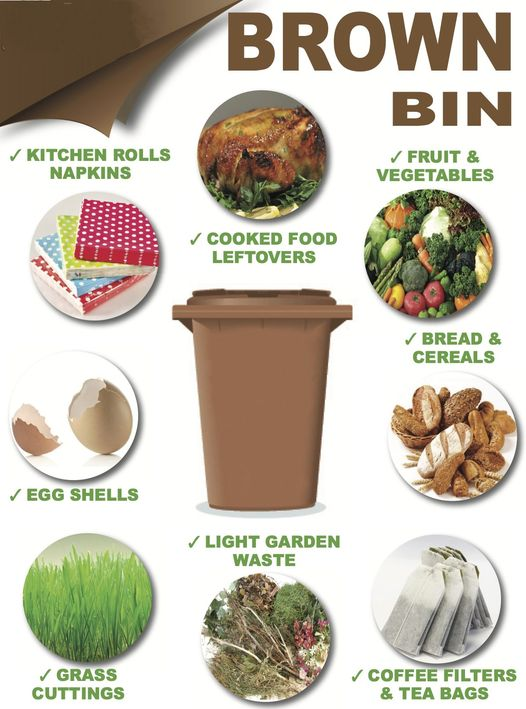
In Ireland, the brown bin plays a crucial role in recycling organic waste. It’s not just for garden waste but also for food items that can be composted. By using your brown bin effectively, you contribute significantly to reducing waste in landfills and aiding in the creation of compost.

EPA Report

A recently published study by the EPA* showed that 21% of the contents of the household residual waste bins was food and garden waste, which could be placed into the brown bin instead, helping to reduce costs for the householder and ensuring that less emitting waste is sent to our landfills. The added bonus of the brown bin is that the organic waste can also be used to make compost, which in turn can be used to help green our towns and cities naturally.

What Goes into the Brown Bin?

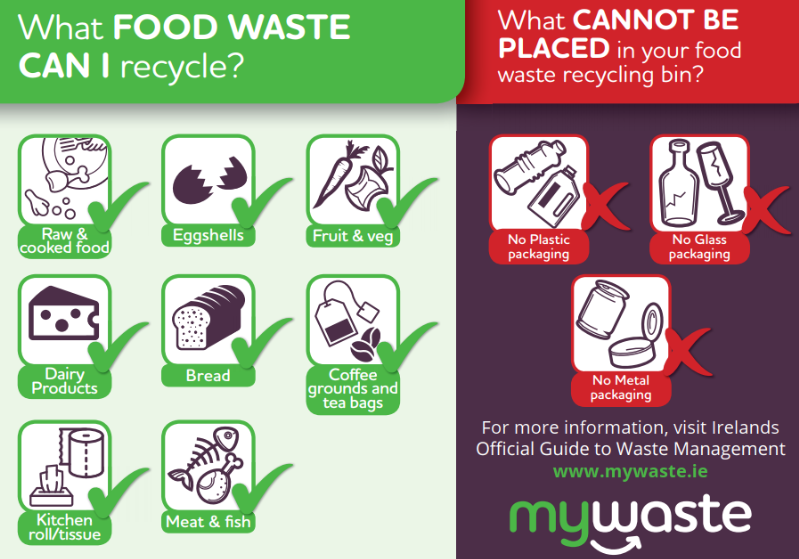
  1. Dairy Products: Items like cheese, yogurt, and butter wrappers can be put into the brown bin. These items decompose and contribute to the production of nutrient-rich compost.
  2. Eggs: Eggshells can be placed in the brown bin. They break down easily and add valuable minerals to the compost.
  3. Raw and Cooked Meat/Fish and Bones: Leftover meat, fish scraps, bones, and even cooked food can go into the brown bin. They decompose and help create compost suitable for enriching soil.
  4. Food-Soiled Paper Napkins and Towels: Used paper napkins, paper towels, and even greasy pizza boxes can be added to the brown bin. However, make sure to remove any large chunks of uneaten food before disposing of these items.

Why Use the Brown Bin for These Items?

  1. Reducing Landfill Waste: Organic waste, such as food scraps and soiled paper products, typically ends up in landfills. By using the brown bin, you divert these materials away from landfills, minimizing environmental impact.
  2. Composting Benefits: When organic waste breaks down in the brown bin, it undergoes composting. This process results in nutrient-rich compost, which is fantastic for enriching soil in gardens and agricultural land. It also reduces the need for chemical fertilizers.
  3. Environmental Impact: Recycling food waste and paper products through the brown bin reduces greenhouse gas emissions associated with decomposing organic matter in landfills. Composting creates valuable soil additives without releasing harmful gases into the atmosphere.

How to Properly Use the Brown Bin:

  1. Separate Your Waste: Ensure you’re segregating your organic waste properly. Use a separate container or bag in your kitchen to collect food scraps and soiled paper items before transferring them to the brown bin.
  2. No Plastic Bags: When disposing of organic waste in the brown bin, avoid using plastic bags. They don’t decompose and can contaminate the compost.
  3. Layering Technique: Consider layering food waste with garden waste or cardboard to help aerate the compost pile in the bin. This can aid in the decomposition process.
  4. Regular Collection: Make sure to put your brown bin out for collection on the designated days. Check your local council’s schedule for collection times and guidelines.

Finally

Using the brown bin in Ireland for recycling is an essential step in responsible waste management. By doing so, we all contribute positively to the environment by reducing landfill waste and producing nutrient-rich compost. Remember to follow the guidelines for proper segregation and disposal, helping create a more sustainable future for all.

Start making a difference today by utilizing your brown bin effectively for organic waste recycling!

About Recycle IT

Recycle IT is an award-winning, not-for-profit, social enterprise established to create employment and promote environmental awareness through recycling and reuse. We work in partnership with WEEE Ireland and are authorized by your local authority to provide electrical, electronic and pure metal recycling collections across Dublin and surrounding areas since 2007. Recycle IT are fully compliant with WEEE collection regulations. Our permit details are available here.

2023 Report – Social Enterprises in Ireland

The Report

The report “Social Enterprises in Ireland: A Baseline Data Collection Exercise” provides a comprehensive overview of the social enterprise sector in Ireland, including its size, economic impact, employment and volunteer participation, and governance structures.

The work was commissioned by the Department of Rural and Community Development (DRCD) and carried out by a consortium. Full details of the consortium can be found in the report.

Please read on to view some of the key findings of the report, download a copy and view a video of social enterprise at work!

Size and Distribution of Social Enterprises

  • There are an estimated 4,335 social enterprises operating in Ireland, with a wide range of activities, including social care, environmental sustainability, community development, and education.
  • Social enterprises are geographically dispersed throughout Ireland, with significant clusters in Dublin, Cork, and Galway.
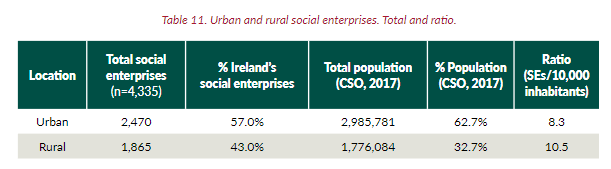
  • There are approximately 8.5 social enterprises per 10,000 inhabitants. 57% of social enterprises are in urban areas (8.3 per 10,000 inhabitants) while 43% are in rural areas (10.5 per 10,000 inhabitants).

Economic Impact

  • Social enterprises generate an estimated €2.34 billion in annual income, representing 0.63% of Ireland’s GDP.
  • Social enterprises employ 84,382 people, (including full-time, part-time employees and contractors). This represents 3.7% of the total Irish workforce.

Employment and Volunteer Participation

  • Social enterprises provide a significant source of employment for people with disabilities, migrants, and other marginalized groups.
  • An estimated 74,825 volunteers participate in the social enterprise sector, including 30,324 board members.
  • The age of the workforce is predominantly between 31 to 50. Women represent 69% of the workforce across the sector and 47% of the workforce is part-time.
  • Labour Market Programmes are an important feature of the sector with 60% of those with paid staff employing people this way.

Governance Structures

  • Social enterprises are governed by a variety of structures, including limited companies, charities, and community interest companies.
  • Social enterprises are increasingly adopting more formal governance structures, such as limited companies, in order to access new sources of funding and grow their businesses.

Challenges and Opportunities

  • Social enterprises face a number of challenges, including a lack of awareness and understanding of the sector, limited access to finance, and a shortage of skilled staff.
  • Social enterprises also represent a significant opportunity to address social and environmental challenges, promote social inclusion, and create sustainable employment opportunities.

The report concludes by outlining a number of recommendations for policymakers, funders, and support organizations to further develop and support the social enterprise sector in Ireland. These recommendations include:

  • Increasing awareness of the social enterprise sector
  • Providing more funding opportunities for social enterprises
  • Developing skills training and support for social enterprises
  • Strengthening the regulatory framework for social enterprises

Overall, the report provides a valuable resource for understanding the social enterprise sector in Ireland and its potential to contribute to a more socially and economically sustainable society.

To access the full report please click here.

About Recycle IT

Recycle IT is a not-for-profit social enterprise providing collection and drop-off services for all types of waste electrical and electronic equipment (WEEE). Yearly Recycle IT offered to drop-off and collection services to thousands of homes and organizations across Dublin and surrounding areas collecting a range of WEEE which includes thousands of computers, televisions, toasters, cables, lawnmowers, monitors, microwaves and kettles.

Recycle IT services are provided in partnership with WEEE Ireland. Recycle IT is supported by South Dublin County Council and authorized by the National Waste Collection Permit Office and the local authorities across Leinster. Recycle IT receive funding thorough the Community Services Programme (CSP) operated by Pobal on behalf of the Department of Rural and Community Development (DRCD)

Watch the video below to learn more.

Video – Pobal and Recycle IT

Visit our website for further details.

National Social Enterprise Conference 2023

5th Annual National Social Enterprise Conference

The Department of Rural and Community Development is delighted to invite you to the 5th Annual National Social Enterprise Conference which will take place on International Social Enterprise Day, Thursday, 16th November, 2023.

This event will be held in the Shearwater Hotel, Ballinasloe. Co. Galway from 9.30am. The conference will also be virtually live-streamed if you can’t be in Ballinasloe on the day.

Event Header

About the day?

Ireland’s National Social Enterprise Policy wisely includes a commitment to hold an annual Social Enterprise Conference as part of its objective to build awareness of Social Enterprise and the services offered to communities across our country. The Conference aims to provide networking opportunities, disseminate information, share experience and inform policy implementation.

What to expect?

  • Key policy updates from the Department of Rural and Community Development including planning for the next Social Enterprise Policy 2024-2027.
  • Panel discussions on trading income, philanthropy, technology, governance and climate action.
  • Networking opportunities with social enterprise practitioners and support organisations.

Just a reminder?

The definition of social enterprise is evolving nationally and internationally and is likely to continue to do so as social enterprises themselves adapt to new societal challenges.

Definition of Social Enterprise – National Social Enterprise Policy for Ireland 2019-2022

The definition will also evolve as national and local governments and wider society understand more fully the nature of social enterprise and their contribution to social and economic development.

How to attend?

Those wishing to attend the event in Ballinasloe are invited to confirm your attendance – either in-person or via live stream – before 30th October at 12pm. Please click here to do so.

The Speakers

Click here to get to know the speakers and panelist for the conference. You can also get an insight into the breakout sessions which you might like to attend on the day.

About Recycle IT

Recycle IT is an award-winning, not-for-profit, social enterprise established to create training, and employment and promote environmental awareness through recycling and reuse. We work in partnership with WEEE Ireland and have been authorized by your local authority to provide electrical, electronic and pure metal recycling collections across Dublin since 2007. Recycle IT is fully compliant with WEEE Recycling Requirements and permit details are available here.

For more information about Recycle IT please click here.

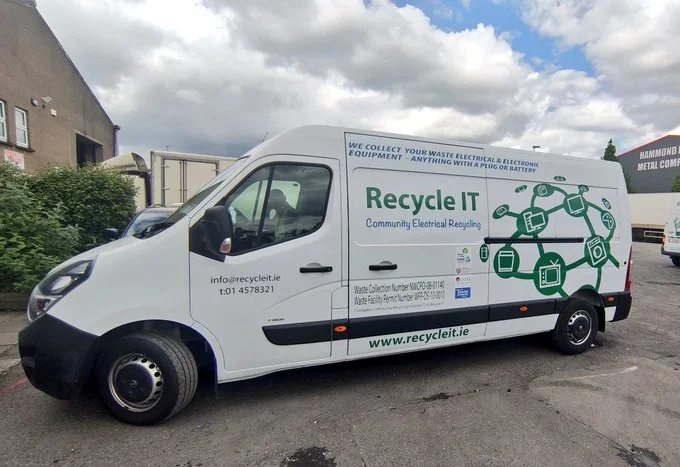
Recycle IT Collection Van

Rowing Machine Recycling

Exercise at Home?

Rowing machines and all exercise equipment should be well looked after so it can be used to improve your health and well-being. This type of equipment is generally designed to help improve fitness levels while also saving time and money on trips to the gym.

After a lot of use over several years, exercise equipment can wear out or simply break down. Machines end up unused and the result is a large rowing machine taking up space in your home. Some people end up using home exercise equipment as clothes dryers.

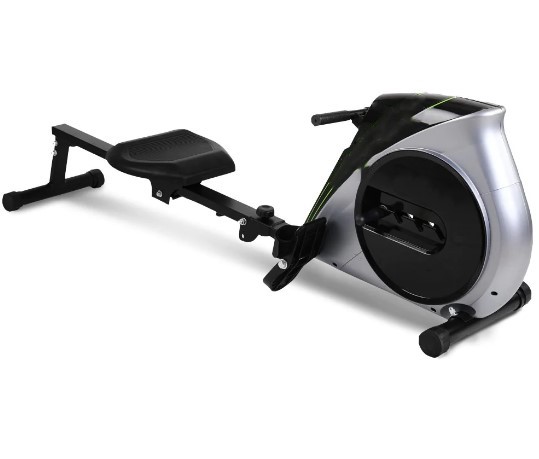
Rowing machine

If this is your situation, please don’t assume that your old rowing machine is worthless. If it’s in good condition, you may be able to sell it or donate it to a charity or community group in your area.

For some households, the removal of a rowing machine that doesn’t work anymore is the hard part. Most manufacturers don’t have a scheme that collects old or damaged equipment for recycling.

Electronic or powered exercise equipment can be described as household appliances. They are larger appliances that have valuable materials, including metal and electronics which when handled correctly can be recycled to extract the material for reuse. This is an opportunity to reduce, reuse, and recycle while supporting the environment.

Reusing Exercise Equipment

If you’ve still got an operational rowing machine, exercise bike, cross trainer, or other fitness equipment, you can try to sell or donate. If your rowing machine is under 8 – 10 years old and was not overused it may suit someone else, If the rowing machine has any mechanical or electronic damage recycling might be best.

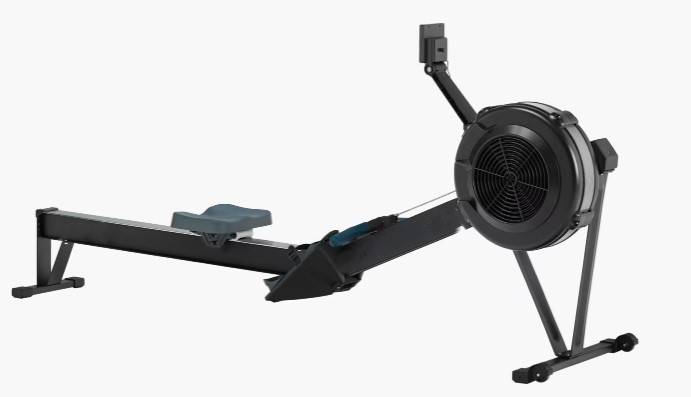
Rowing Machine

Anyone buying a used machine should think about how to transport it, do a visual inspection, and get advice on the mechanical and electronic components. Maybe bring someone along who has knowledge of testing exercise equipment. 

Recycling Exercise Equipment

If the equipment really is no longer functional, contact the manufacturer to check the warranty or service options and ask about any take-back scheme.

In Europe, some countries have started to require manufacturers to have the plan to take back and recycle equipment at the end of its life. This type of scheme is known as extended producer responsibility It started to apply to exercise equipment in France in 2022. You will find details on Ireland’s extended producer responsibility schemes here, last updated on September 5th, 2022.

If the above options don’t work for you, you can always safely recycle your old rowing equipment and more (treadmills, cross trainers, exercise bikes, etc) with a collection from Recycle IT

Recycle IT currently accepts dozens of old treadmills and bikes each year for safe recycling, some are damaged, parts are missing, or their owners are moving country or downsizing home and can’t take a rowing machine or treadmill along.

No matter, what your reason, if you wish to dispose of old or unused exercise equipment recycling is worthwhile. The metal, plastic and electronic components will be dismantled, separated, and broken down for future reuse in new products.

Recycle IT offers cost-effective collections in Dublin and surrounding areas so send us an email including your location and we will get back to you.

You can read more about recycling treadmills here.

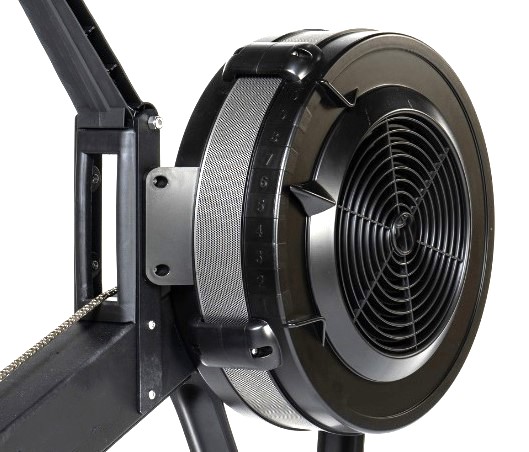
Part of a Rowing Machine

About Recycle IT

Recycle IT is an award-winning not-for-profit social enterprise providing a collection and drop-off service for all types of waste electrical, electronic and metal items.

Our electrical community collection service is provided in partnership with WEEE Ireland. Recycle IT is supported by Pobal, South Dublin County Council and authorized by the National Waste Collection Permit Office and the local authorities across Leinster.

To speak with Recycle IT please call 01 4578321 or email us here

Visit our website www.recycleit.ie

Social Enterprise Conference Dublin – May 2023

Oakfield Trust presents an international conference entitled ‘Social Enterprise. Achieving Real Social Impact and Developing the Space’ in the warm surroundings of the wonderful Wood Quay Venue in Dublin City.

About the Organiser

Oakfield Trust based in Clondalkin provides a range of property-based services and related support for community and local projects. These supports offer projects a chance to develop and succeed – thereby benefitting the whole community.

The primary activity is Property Management & Development involving the acquisition, customisation and management of properties that are leased to organisations working with marginalised groups in socially excluded communities.

Oakfield Trust also provided assistance to local organisations in the form of Project Development Loans and Grants as well as New Build Project Management.

The Conference

The team at Oakfield Trust are looking forward to an open, thought-provoking event with contributions and discussion from highly regarded figures from the sector and many opportunities for audience participation.

The conference will run from 9.45am to 13.30pm on May 24th 2023, at The Wood Quay Venue, Fishamble Street, Wood Quay, D08 RF3F.

Dublin City Council – Wood Quay Venue, D8

The event will feature:

MC / Moderator – Susan Hayes Culleton

Main Speakers:

  • Joyce Murray (Founder and CEO, Grace Chocolates in Scotland)
  • Karen Leigh (Founder and CEO, Sensational Kids in Ireland).

Panel Discussion 1: ‘Achieving Real Social Impact’ – featuring:

  • Siobhán Cafferty (Social Enterprise Project Manager, Working to Change)
  • Emma Connors (CEO, Recreate)
  • Ivan Cooper (CEO, The Wheel)
  • John Lonergan (Former Governor, of Mountjoy Prison)
  • Joyce Murray (Founder and CEO, Grace Chocolates, Scotland)

Panel Discussion 2: ‘Developing the Social Enterprise Space’ – featuring:

  • Lorraine Corcoran (Director, SERI)
  • John Kearns (CEO, Partas)
  • Una Lavelle (General Manager, Recycle IT)
  • Karen Leigh (CEO, Sensational Kids)
  • Donal Traynor (Group CEO, Community Finance)

Video contributions from sector figures at home and abroad.

To book your place, learn more, get directions, parking information and view the frequently asked question section please click here.

About Recycle IT

Recycle IT is an award-winning not-for-profit social enterprise providing a collection and drop-off service for all types of waste electrical, electronic and metal items. Recycle IT offer drop-off and collection services to both homes and organizations in Dublin and surrounding areas collecting a range of WEEE which includes thousands of printers and we can help recycle yours!

Our electrical community collection service is provided in partnership with WEEE Ireland. Recycle IT is supported by Pobal, South Dublin County Council and authorized by the National Waste Collection Permit Office and the local authorities across Leinster.

To speak with Recycle IT please call 01 4578321 or email us here

Visit our website www.recycleit.ie

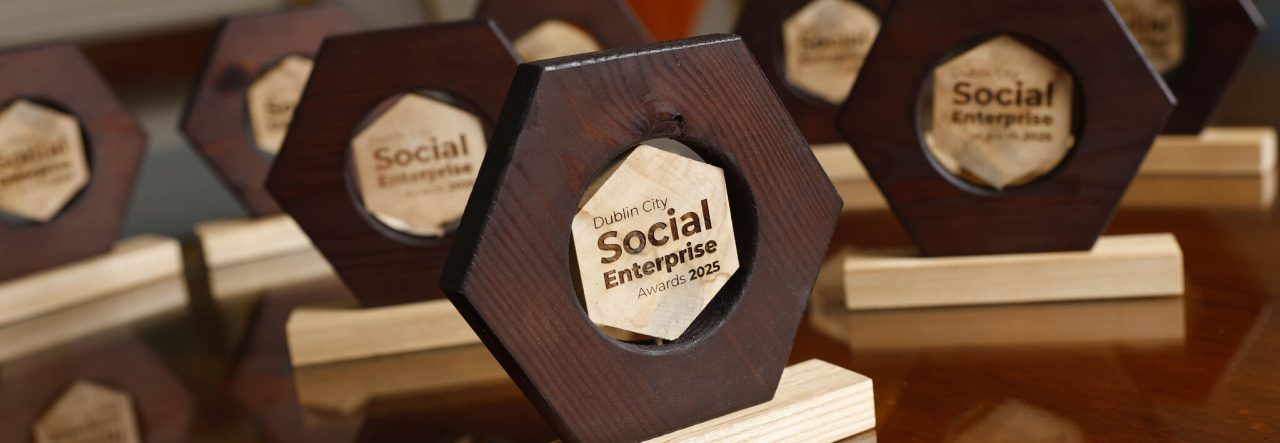
Recycle IT are Awardees for 2023