2023 Report – Social Enterprises in Ireland

The Report

The report “Social Enterprises in Ireland: A Baseline Data Collection Exercise” provides a comprehensive overview of the social enterprise sector in Ireland, including its size, economic impact, employment and volunteer participation, and governance structures.

The work was commissioned by the Department of Rural and Community Development (DRCD) and carried out by a consortium. Full details of the consortium can be found in the report.

Please read on to view some of the key findings of the report, download a copy and view a video of social enterprise at work!

Size and Distribution of Social Enterprises

  • There are an estimated 4,335 social enterprises operating in Ireland, with a wide range of activities, including social care, environmental sustainability, community development, and education.
  • Social enterprises are geographically dispersed throughout Ireland, with significant clusters in Dublin, Cork, and Galway.
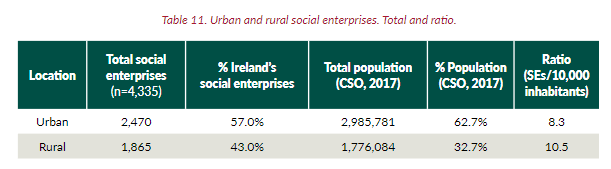
  • There are approximately 8.5 social enterprises per 10,000 inhabitants. 57% of social enterprises are in urban areas (8.3 per 10,000 inhabitants) while 43% are in rural areas (10.5 per 10,000 inhabitants).
Economic Impact

  • Social enterprises generate an estimated €2.34 billion in annual income, representing 0.63% of Ireland’s GDP.
  • Social enterprises employ 84,382 people, (including full-time, part-time employees and contractors). This represents 3.7% of the total Irish workforce.

Employment and Volunteer Participation

  • Social enterprises provide a significant source of employment for people with disabilities, migrants, and other marginalized groups.
  • An estimated 74,825 volunteers participate in the social enterprise sector, including 30,324 board members.
  • The age of the workforce is predominantly between 31 to 50. Women represent 69% of the workforce across the sector and 47% of the workforce is part-time.
  • Labour Market Programmes are an important feature of the sector with 60% of those with paid staff employing people this way.

Governance Structures

  • Social enterprises are governed by a variety of structures, including limited companies, charities, and community interest companies.
  • Social enterprises are increasingly adopting more formal governance structures, such as limited companies, in order to access new sources of funding and grow their businesses.

Challenges and Opportunities

  • Social enterprises face a number of challenges, including a lack of awareness and understanding of the sector, limited access to finance, and a shortage of skilled staff.
  • Social enterprises also represent a significant opportunity to address social and environmental challenges, promote social inclusion, and create sustainable employment opportunities.

The report concludes by outlining a number of recommendations for policymakers, funders, and support organizations to further develop and support the social enterprise sector in Ireland. These recommendations include:

  • Increasing awareness of the social enterprise sector
  • Providing more funding opportunities for social enterprises
  • Developing skills training and support for social enterprises
  • Strengthening the regulatory framework for social enterprises

Overall, the report provides a valuable resource for understanding the social enterprise sector in Ireland and its potential to contribute to a more socially and economically sustainable society.

To access the full report please click here.

About Recycle IT

Recycle IT is a not-for-profit social enterprise providing collection and drop-off services for all types of waste electrical and electronic equipment (WEEE). Yearly Recycle IT offered to drop-off and collection services to thousands of homes and organizations across Dublin and surrounding areas collecting a range of WEEE which includes thousands of computers, televisions, toasters, cables, lawnmowers, monitors, microwaves and kettles.

Recycle IT services are provided in partnership with WEEE Ireland. Recycle IT is supported by South Dublin County Council and authorized by the National Waste Collection Permit Office and the local authorities across Leinster. Recycle IT receive funding thorough the Community Services Programme (CSP) operated by Pobal on behalf of the Department of Rural and Community Development (DRCD)

Watch the video below to learn more.

Video – Pobal and Recycle IT

Visit our website for further details.
Circular Economy: Know more

Circular Economy: Learn more

In 2014, the European Commission (EC) put forward an initial Circular Economy proposal to address the issue and help European businesses and consumers make the transition to a circular economy where waste is viewed as a ‘resource’ that can be recycled, re-used or remanufactured.

The plan will be backed by €5.5bn from the European Structural and Investment Fund (ESIF) and €650m from Horizon 2020 (the EU funding programme for research and innovation).

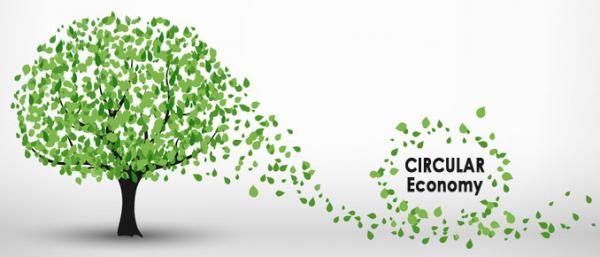
Circular Economy Tree

What is the status with EU waste policy today?

The 2008 Waste Framework Directive sets the overarching legislative framework for EU waste policy. The directive sets binding targets to be achieved by 2020: preparing for reuse and recycling of 50% of certain waste materials from households and similar sources, and preparing for reuse, recycling and other recovery of 70% of construction and demolition waste.

Meanwhile, the 1999 Landfill Directive bans landfilling of untreated waste. The directive sets a goal that the share of biodegradable municipal waste going to landfills may not be greater than 35% in 2016, compared to the baseline year of 1995.

The aims are to protect the environment and to safeguard the functioning of the internal market. It requires Member States to take measures to prevent packaging waste and to develop packaging reuse systems.

When will it happen?

The proposal is currently going through the EU legislative process. Before the Circular Economy proposal is passed into law, all three European institutions (the European Council, European Parliament and the European Commission) must have an agreed stance, which they will then take into a series of discussions.

Both European Parliament and Council of Ministers can amend the legislation but must agree upon the same text before the bills can become law. This means that a final proposal will likely not be established until the second half of 2017. Malta, currently hold the EU Presidency, hope to reach a deal with MEPs before 1 July, as its six-month Presidential term ends.

What does the change mean?

The targets listed under the Circular Economy proposal will be implemented by national governments across the EU Member States (including Ireland) and are targeted at the waste performance of households and businesses.

What are the targets listed under the proposal?

The original Circular Economy proposal intended to increase recycling levels and tighten rules on incineration and landfill. It consists of six individual bills on waste, packaging, landfill, end-of-life vehicles, batteries and accumulators, and waste electrical and electronic equipment (WEEE).

Evolving Circular Economy
Evolving Circular Economy –

The re-tabled proposal, unveiled in December 2015, included eco-design rules for products to make them easier to recycle. But it also had lower 2030 targets for recycling municipal and packaging waste, and replaced a 2025 aspirational landfill reduction target of 25% with a mandatory 10% goal for 2030.

This target was recently rejected as” watered-down” ambitions. A vote has advocated to reinstate the 70% target for municipal waste recycling, strengthening current proposals by 5%.

Meanwhile, a 2030 target for packaging recycling was voted to be 80% – higher than the 75% previously backed by the Commission. And the waste-to-landfill target has been restricted to 5%, replacing a mandatory target of 10% by 2030. MEPs have also voted for a European Union (EU) food waste reduction target of 30% by 2025 and 50% by 2030, compared to 2014.

The proposal includes a series of additional measures and targets, including:

  • The promotion of economic incentives to discourage landfilling;
  • A ban on landfilling of separately collected waste;
  • Simplified and improved definitions and harmonized calculation methods for recycling rates throughout the EU;
  • Define measures to promote re-use and stimulate industrial symbiosis – turning one industry’s by-product into another industry’s raw material;
  • Economic incentives for producers to put greener products on the market and support recovery and recycling schemes (e.g. for packaging, batteries, electric and electronic equipment, vehicles).
  • Four legislative proposals (included) are legal acts: Waste Framework Directive; Landfilling Directive; Packaging Waste Directive; Directives on end-of-life vehicles, on batteries and accumulators and waste batteries and accumulators, and on waste electrical and electronic equipment (WEEE).

About Recycle IT

Recycle IT is an award-winning not for profit social enterprise providing a collection and drop off service for all types of waste electrical and electronic equipment (WEEE). During 2016 Recycle IT supported drop off and collection services to over 100,000 homes, schools, charities and businesses across Dublin and surrounding areas collecting a range of WEEE which includes thousands of computers, cables, monitors, microwaves and TV’s.

Recycle IT services are provided in partnership with WEEE Ireland. Recycle IT are supported by Pobal, South Dublin County Council and authorized by the National Waste Collection Permit Office and the local authorities across Dublin, Kildare and Wicklow.

To learn more about Recycle IT or to book a collection or drop off please call 01 4578321 or email us here.

Recycle IT - Pakman Award Winner 2016
Recycle IT – Pakman Award Winner 2016