Electrical Recycling – Do more this year!

Research from WEEE Ireland

WEEE Ireland, Ireland’s large waste electrical compliance scheme says over 15 million small appliances such as coffee makers, calculators, kettles and keyboards were handed back for safe recycling. This is alongside with the equivalent of 66 million used AA batteries which made there back to into the circular economy.
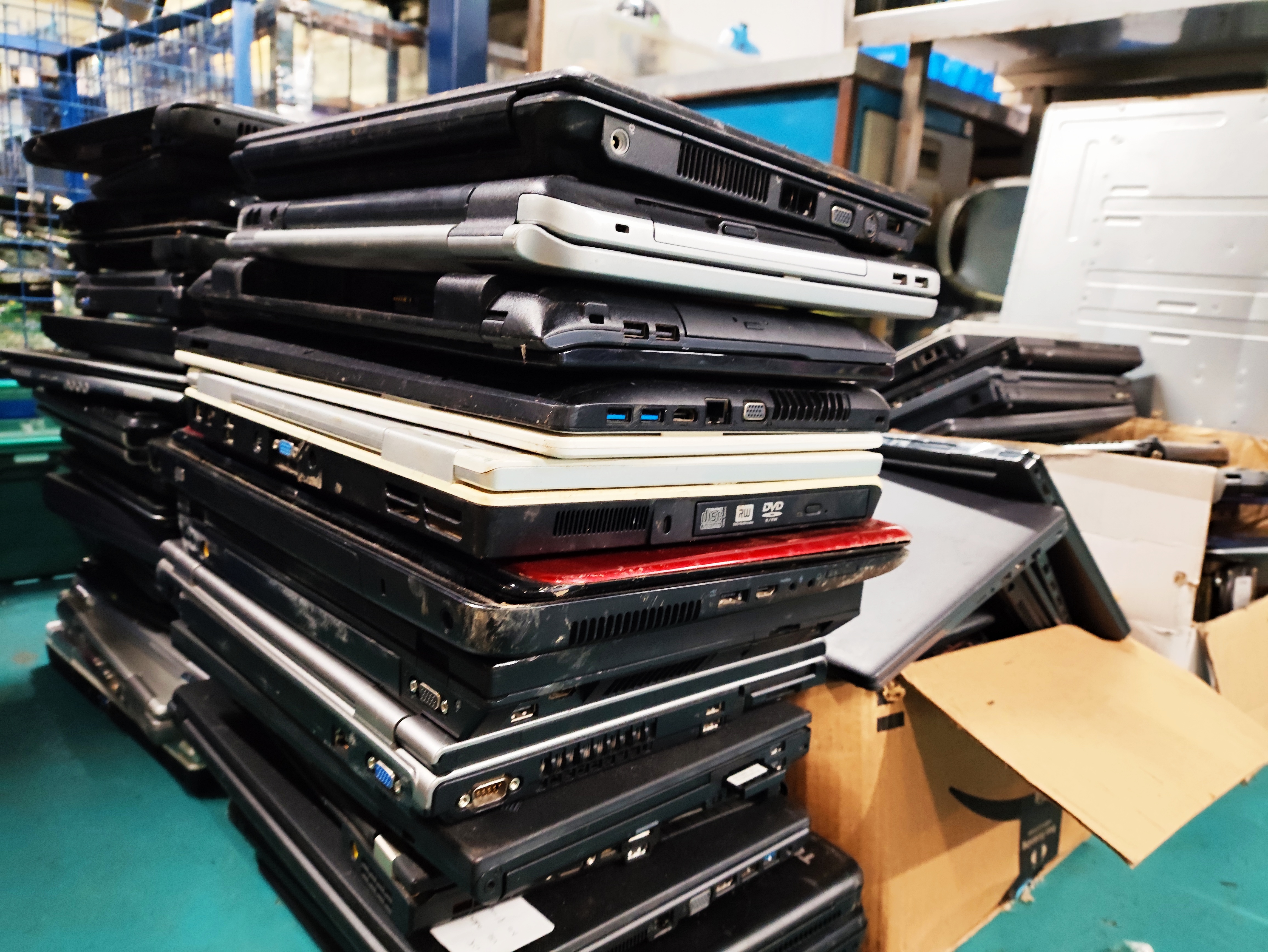
Mixed Cables and Chargers

WEEE figures also reveal that, for every 10 new tech products sold in Ireland, only 4 are eventually coming back for recycling when they become obsolete. Did you know, one in four 18-24-year-olds and one in five aged 35-44 get rid of common household electrical items such as smart watches, earbuds and blue tooth speakers in general waste bins. 

Almost half of Ireland’s small electronics are bought in November and December each year – but data from WEEE Ireland shows only one in three are coming back for recycling.
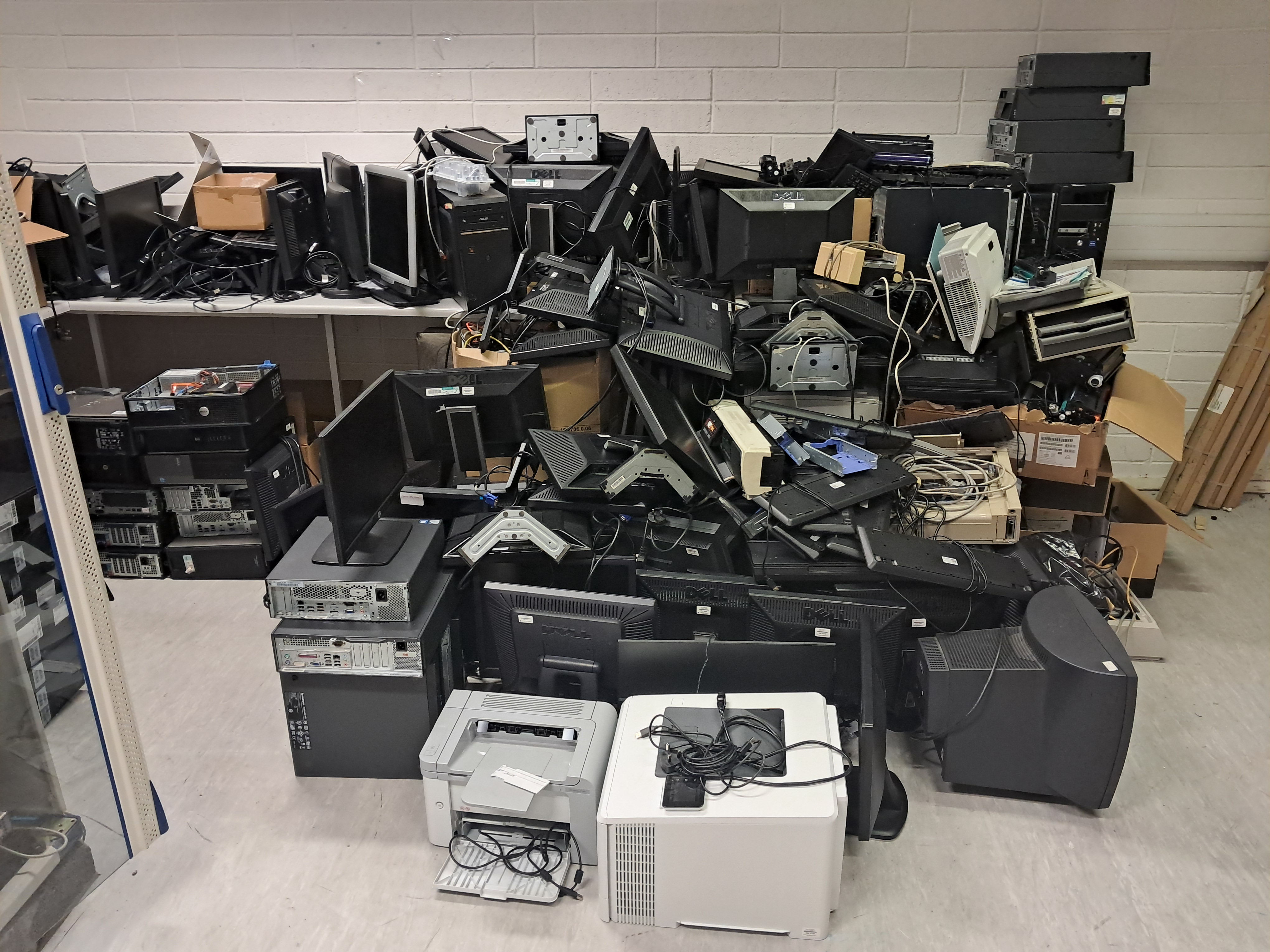
Mixed Electronic Equipment

The Waste Electrical and Electronic Equipment (WEEE) Ireland figures reveal more than 11 million small electronic items from personal grooming to tech were bought here last year, 4.4 million of them across Black Friday and Christmas.

People’s concerns about personal data are stopping one in five (21%) adults from recycling their unused tech items – while a further 22% of adults keep old technology equipment as backups, new research reveals.

The Empathy Research survey for WEEE Ireland, the largest Irish not-for-profit compliance scheme also found that 12% of people still put small electronic waste items in general household bins. This is truly unbelievable!
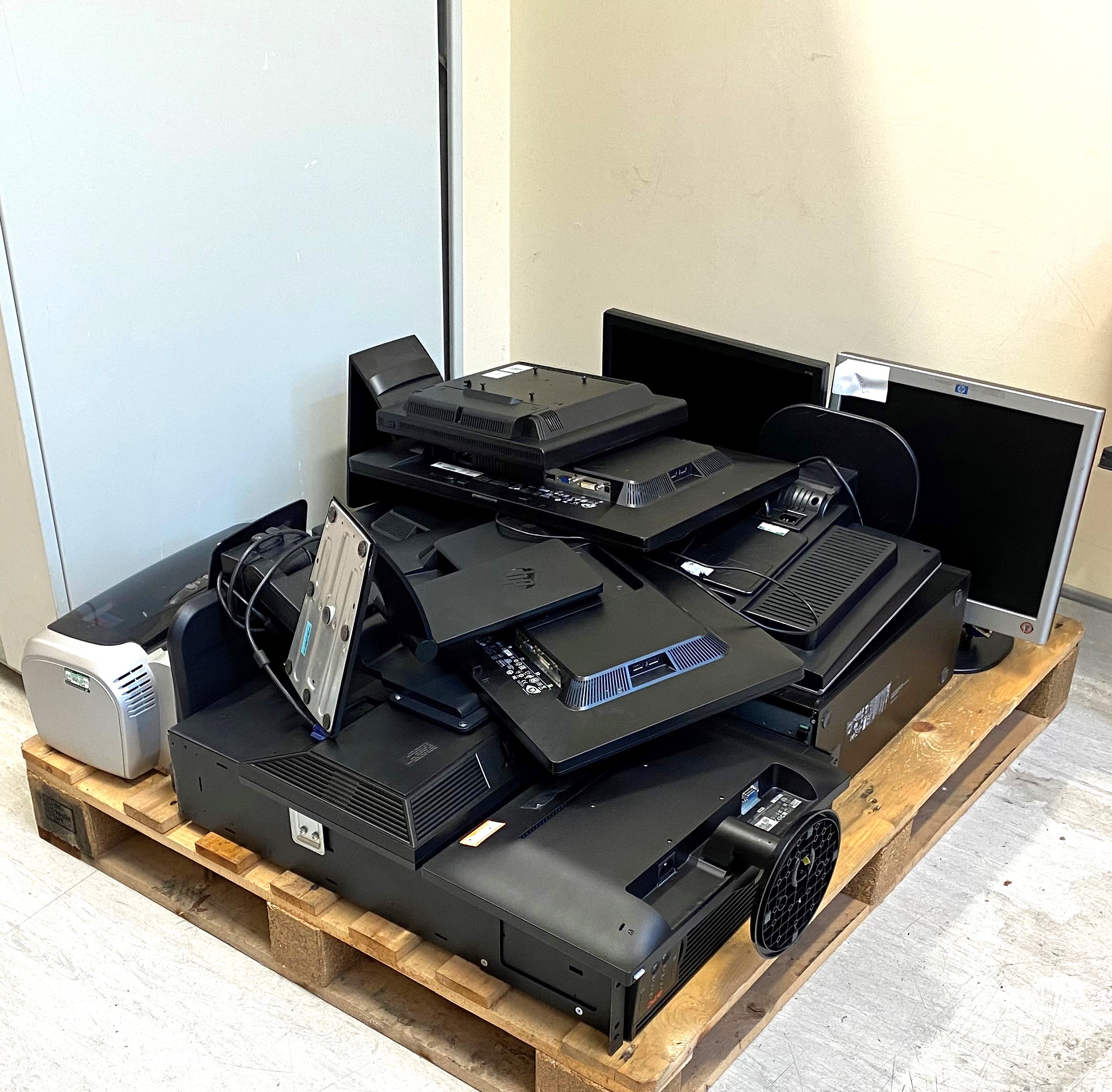
Mixed Electronic Equipment

Storing and hoarding

Digital hoarding, e-hoarding, e-clutter, data hoarding, or cyber hoarding are all terms used to describe keeping IT equipment beyond a reasonable time for use.

In Time Magazine Pascal Leroy, director general of the WEEE Forum, a Brussels-based association of global e-waste management organizations, says “It’s really an issue of great concern, this hoarding, and it’s difficult to address because it’s about consumer behaviour—why do people behave the way they do?” says “There is something in us that prevents us from properly disposing of it or properly recycling it.”
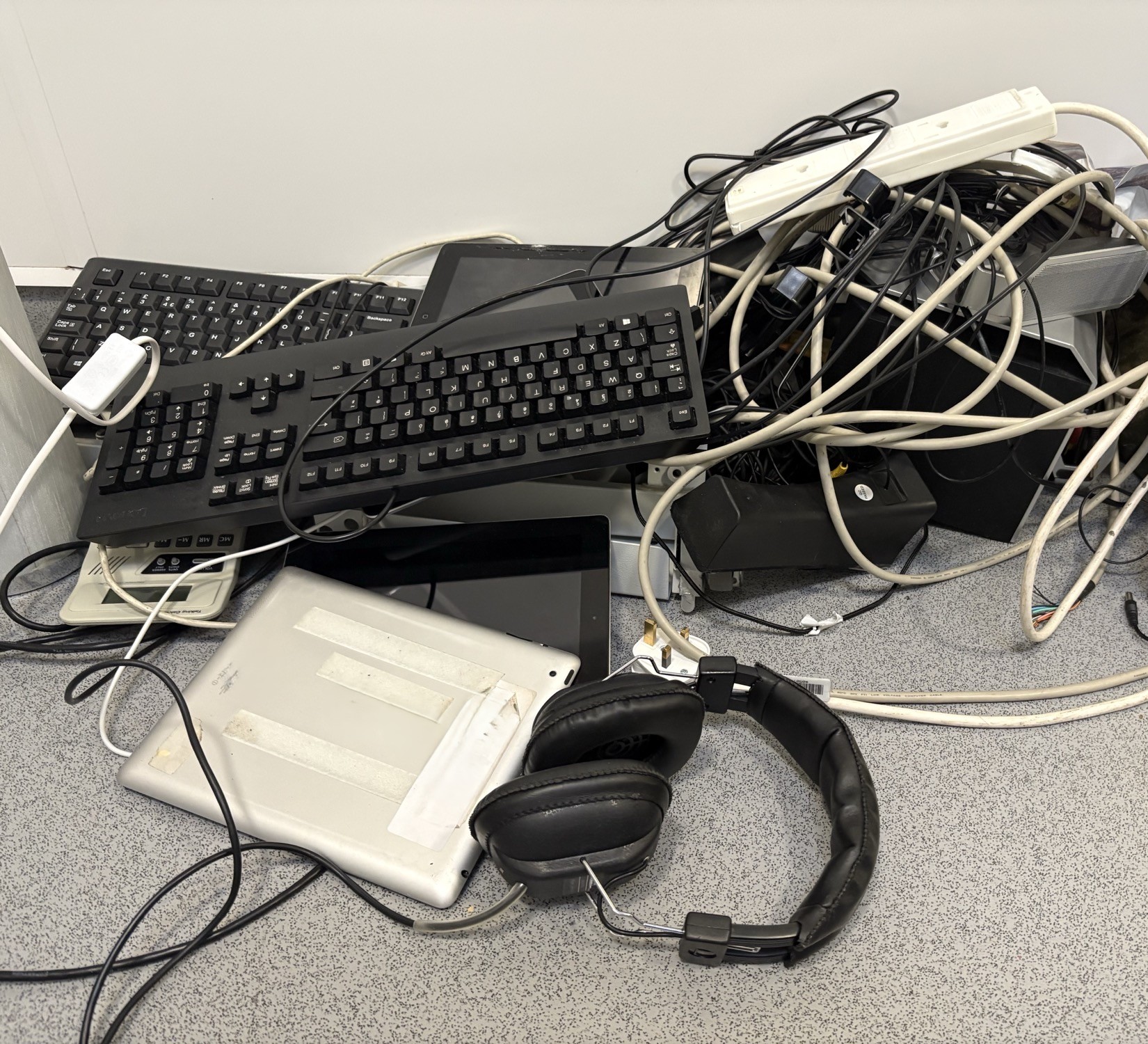
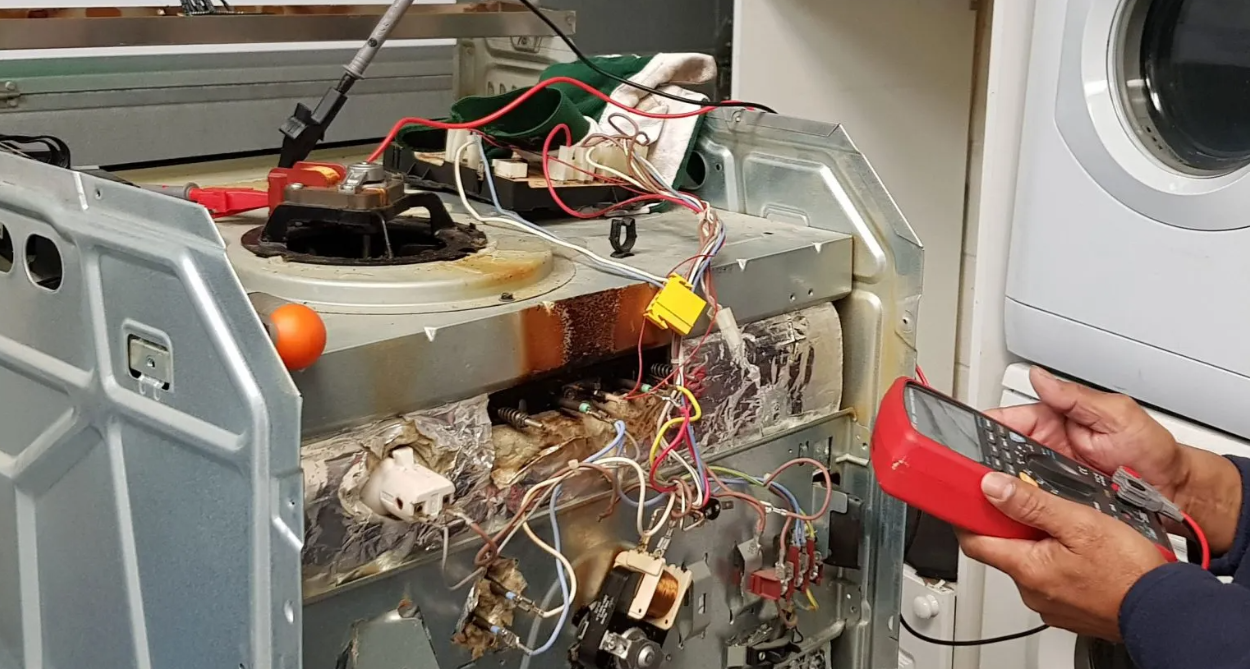
Old Electronic Equipment – Home or Office

When you choose to store or hoard older items (no longer used) you are limiting the number of reusable resources available to produce new electronic items. There are lots of components in older equipment that can be reused in the manufacturing of new mobile phones, tablets, or laptops.

For example, the plastic and glass from screens/monitors can be reused, therefore limiting the amount of glass and plastic that is required to create new monitors.

Recycling your old phones, tablets, and laptops with Recycle IT also helps create work experience opportunities and local jobs which is beneficial to the local community.

You can read more about this topic here.

Doing more!

CEO of WEEE Ireland, Leo Donovan, is now urging consumers to dig out old and broken tech and their accessories for recycling, emphasising the straightforward nature of backing up and wiping old devices.

“Most phone and laptop manufacturers have user-friendly instructions on their websites for backing up and deleting data, ensuring that valuable information is not lost or exposed.

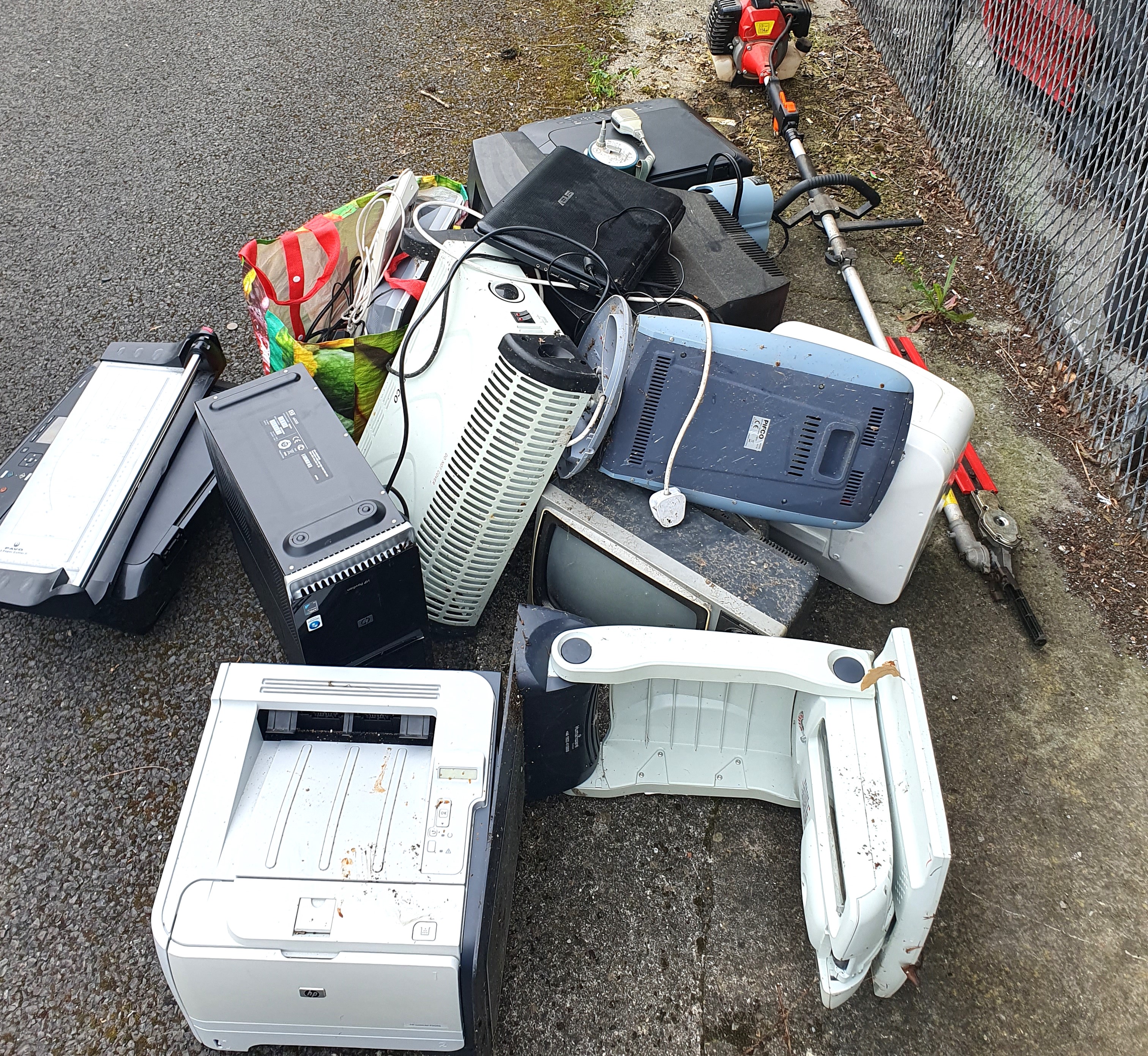
Mixed Electronic and Electrical Equipment

“If recycled correctly, these old and broken devices, along with their integrated batteries, chargers and cables, provide a significant source of critical and strategic secondary raw materials,” said Mr Donovan.

Recycling laptop, mobile phones and other household and personal electronic devices help reduce the use of new natural resources.

About Recycle IT

Recycle IT is an award-winning not-for-profit social enterprise providing a collection and drop-off service for all types of waste electrical, electronic and metal items.

Recycle IT offer drop-off and collection services to both homes and organizations in Dublin and surrounding areas collecting a range of WEEE which includes thousands of printers and we can help recycle yours!

If you require data destruction we can offer a cost-effective service to households and organisations. Just email us to find out more.

Our electrical community collection service is provided in partnership with WEEE Ireland. Recycle IT is supported by Pobal, South Dublin County Council and authorized by the National Waste Collection Permit Office and the local authorities across Leinster.

To speak with Recycle IT please call 01 4578321 or email us here

Visit our website www.recycleit.ie
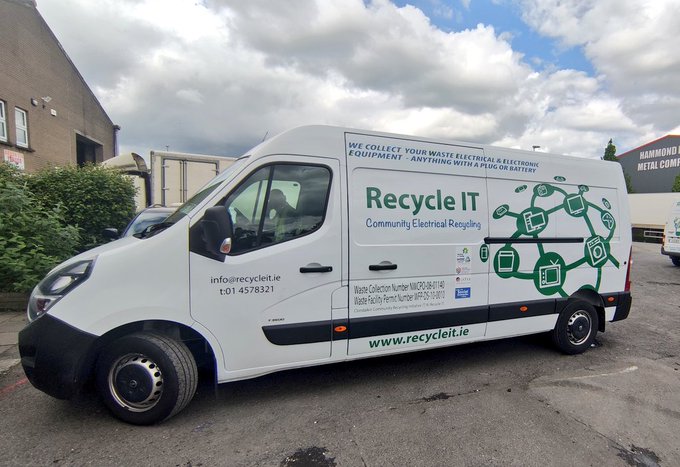
Recycle IT Van 2025

Electrical Recycling Updates!

Technology is now part of our everyday live. From home to offices, buses to boats, school and colleges, computers tablets, PCs severs, and related software are an indispensable part of our modern life. Add personal items like smart watches, mobile phones, virtual assistants, and robot vacuums and mowers and we are all are touched by helpful or essential tech.

The downside is the lifespan with some items breaking sooner than they should or people always wanting the latest and greatest meaning items become waste or e-waste which is a major concern for the planet we live on!

What is e-waste?

According to the European Union (EU), electronic and electrical waste, or e-waste, covers a variety of different products that are thrown away after use.

These include:

  • Large household appliances, such as washing machines and electric stoves
  • IT and telecommunications equipment (laptops, printers)
  • Consumer equipment (video cameras, fluorescent lamps) and photovoltaic panels
  • Small household appliances (vacuum cleaners, toasters)
  • Other categories, such as electrical tools and medical devices

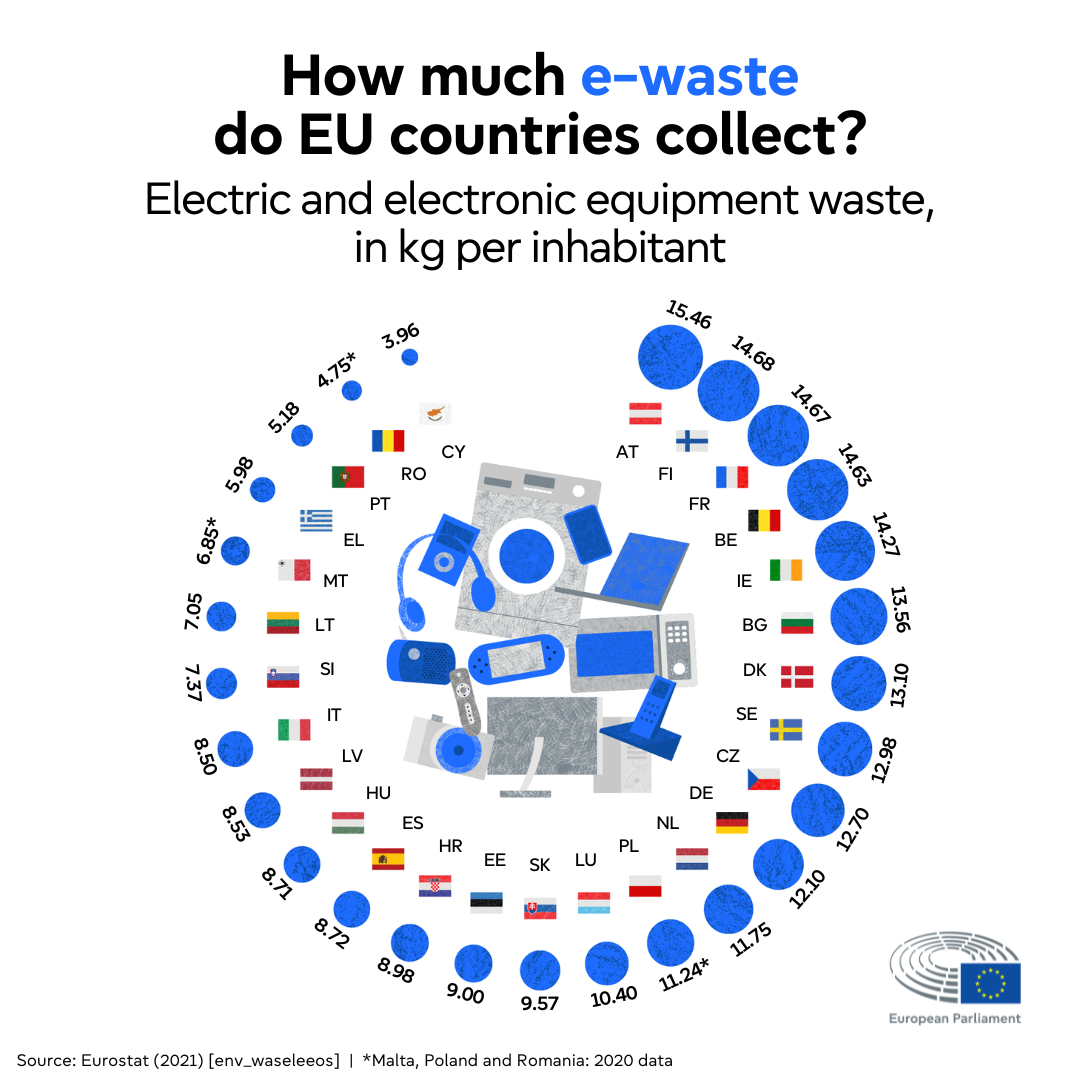
The EU also say e-waste is one of the fastest growing waste streams in the Europe and less than 40% is recycled. You can view the facts and figures in the infographic below.

You can use the infographic to find out how many kilos of electronic equipment have been collected per inhabitant in Ireland and other EU countries.

Recycling practices vary among EU countries. In 2021, Austria topped the EU countries in electronic waste collection, with an average of 15.46 kilos per inhabitant. In 2021, 11 kilos of electrical and electronic equipment waste were collected per inhabitant in the EU on average.

Why recycle electronic and electrical waste?

Cast off electronic and electrical equipment contains potentially harmful materials that pollute the environment and increase the risks for people involved in recycling e-waste. To counter this problem, the EU has passed legislation to prevent the use of certain chemicals, like lead.

The EU say, many rare minerals that are needed in modern technology come from countries that do not respect human rights. To avoid inadvertently supporting armed conflict and human rights abuses, MEPs have adopted rules requiring European importers of rare earth minerals to carry out background checks on their suppliers.

USB Type-C

Changes for Us

The European Commission presented a new circular economy action plan in 2020 that has as one of its priorities the reduction of electronic and electrical waste. The proposal specifically outlined immediate goals like creating the right to repair and improving reusability in general, the introduction of a common charger and establishing a rewards system to encourage recycling electronics.

  • USB Type-C will become the common charger for most electronic devices in the EU by the end of 2024. Laptops will have to be equipped with a USB Type-C port by 28 April 2026.
  • The Commission presented a new proposal to promote repairing and reusing goods. Within the legal guarantee It would require sellers to repair products unless it is cheaper to replace them. Beyond the guarantee, it would provide rights to make repairs easier and cheaper.
  • The EU has adopted rules on the collection, treatment and recycling of electrical and electronic equipment to tackle the issue of the growing amount of electronic waste.
  • The Commission put forward a proposal for an update of the directive on waste electrical and electronic equipment to implement a ruling of the European Court of Justice concerning the scope of obligations of producers of photovoltaic panels (solar panels).

The EU council has now adopted these amendments into the EU law on waste from electrical and electronic equipment (WEEE). Read more here.

Further updates will follow over the coming months. To reads more now please click here.

Repair and Reuse

Irish Statistics

The Irish Environmental Protection Agency (EPA) released 2022 statistics data related to the waste electrical and electronic equipment (WEEE) statistics for the whole of Ireland which documents household dual use B2C and commercial, professional B2B WEEE takeback.

The following key trends can be highlighted:

  1. 66,018 tonnes of WEEE were collected for treatment in Ireland in 2022, a decrease of 8% from the quantity collected in 2021.
  2. 61,806 tonnes of WEEE were recovered and 54,245 tonnes were prepared for reuse or recycling in 2022, a decrease of 8% and 9% respectively from the quantities in 2021.
  3. Large equipment (e.g. Cookers, washing machines) accounted for 53.2% (by weight) and small equipment (e.g. Kettles, toasters) represented the next largest category accounting for 19.9% of WEEE collected.
  4. Ireland met the EU recovery, recycling and reuse targets for all six categories of WEEE in 2022, they are temperature exchange equipment, screens, monitors, and equipment containing screens, lamp, large appliances, small appliances, and small IT.

The Irish national statistics show Ireland is in line with many European Member States but WEEE recycling volumes are not achieving 65% collection target.

Ireland 2023

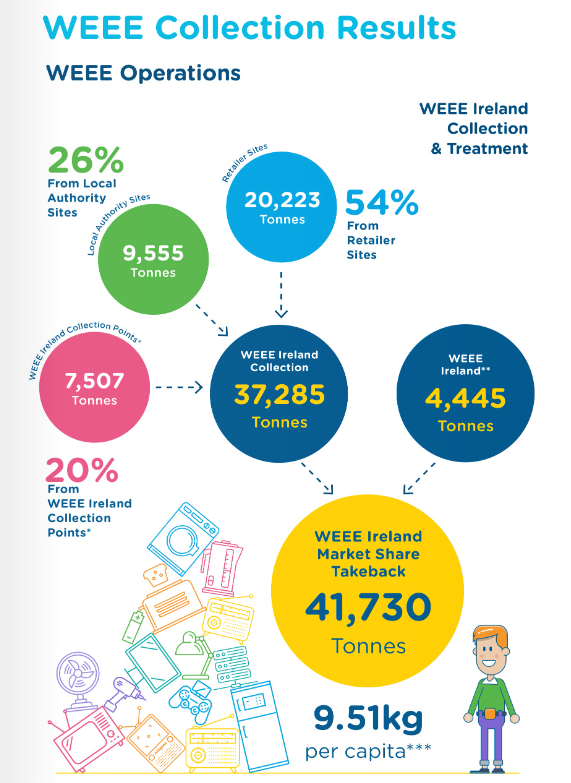
WEEE Ireland Collection Results 2023

Recent figures in WEEE Irelands annual environmental report reveal consumers recycled a record-breaking 41,730 tonnes of electronic and electrical waste in 2023 – the equivalent of almost 200 forty-foot containers more than the previous year. Great News!

You all help by recycling over 15 million small appliances such as coffee makers, calculators, kettles and keyboards, along with the equivalent of 66 million used AA batteries were also handed back to make their way into the circular economy.

To view the full WEEE Ireland Annual Environmental Report for 2023 please click here.

About Recycle IT

Recycle IT is an award-winning, not-for-profit, social enterprise established to create employment and promote environmental awareness through recycling and reuse. We work in partnership with WEEE Ireland and are authorized by your local authority to provide electrical, electronic and pure metal recycling collections across Dublin since 2007. Recycle IT are fully compliant with WEEE collection regulations. Our permit details are available here.

Recycle IT – Community Recycling Initiative of the Year 2023

35 Easy Tips to Reduce and Save!

Going Greener – Making it Easy!

Recycling is an easy way to protect our environment and climate while ensuring the wellbeing of our community for the next generation. However, the success of recycling depends on the active participation of every member of the community including kids of all ages.

By everyone doing a little, we all can reduce the amount of waste that is deposited in the landfill or incinerated. Thinking about the reuse of items made from recycled materials helps maintain the recycling circle and its part in the circular economy.

Photo by Burak The Weekender on Pexels.com

We have listed 35 reuse and recycling tips – You might adapt some!

  • Use both sides of the page when writing or drawing.
  • Give your kids or local schools part used printed paper for drawing.
  • Bring your food to school or work using a reusable tub.
  • Rent or hire schoolbooks and supplies (reuse).
  • Hire gardening tools that you only use occasionally.
  • Make a bird feeder by reusing a medium size plastic bottle. 
  • Choose low-energy light bulbs at home and in the office.
  • Give your unwanted clothes a second life.
  • Reuse and repair as much as possible – shoes, clothes etc.
  • Offer seasonal kids costumes to clothes to others as your kids grow!  
  • Choose to buy bars of soap.
  • Choose long life or durable products e.g. reusable razors or ink pens.
  • Use rechargeable batteries in home appliances.
  • Avoid unnecessary purchasing of occasion products, e.g. Christmas, Easter
  • Offer gifts, such as tickets for a show, sports event or concert leading to reduce material content.
  • Choose eco-friendly products – read the labels.
  • Buys product with less or no packaging.
  • Buy regularly household products in bulk, e.g. canned and jarred products.
  • Reuse shopping bags.
  • Use refillable products e.g. pasta, rise, coffee, loss tea.
  • Drink taps water from reusable bottles.
  • Bring lunch to school, college, or work.
  • Prepared food at home for picnics while reusing flasks, tubs, knives, forks, and reusable carry bags.
  • Choose fresh food rather than processed food, healthier and less packaging.
  • Bake cakes and muffins instead of buying! 
  • Limited home and office printing, share files over email or file sharing tools e.g. Dropbox.
  • Recycle ink cartridges – where you purchased your ink! 
  • Bring a mug and glass to work to refill coffee, tea or water during the working day.
  • Approach office supply companies about purchasing used office equipment.
  • Cycle to work or college rather than taking the bus or car.
  • Car share where distances are longer and where public transport is not accessible.
  • Take your uneaten food home from restaurants in a doggy bag.
  • Composite garden cuttings and waste plant-based food to create a natural fertilizer.
  • Reuse school uniforms and junior football club kits – Kids grown fast!
  • Sort waste like plastics for reuse or safe recycling.
Photo by Krizjohn Rosales on Pexels.com

Reduce, Reuse, Repurposing and Recycling

In Ireland and across Europe, the focus on the 3 R’s has increased over recent years as recovery of resources through, reduce, reuse, repurposing and recycling has increased it has become increasingly important for consumers to take ownership and steps themselves to ensure products purchases can be reused, repurposed, or recycled using accessible and economically sustainable solutions.

Recycle IT – What we are doing?

Recycle IT offer electrical, electronic, and pure metal recycling services directly to people’s homes. We work with local area reps and residents associations to offer free residents recycling in estates in many areas of Dublin.

We encourage people to take advantage of this free drop off and cost-effective personal and business collections. We do offer and safely manage services to community groups, charity organisations, schools, and colleges so rest assured we have a service to match your needs.

Photo by Mike Bird on Pexels.com

By recycling your waste electrical and electronic equipment you help the environment and our organisation create training and employment opportunities that otherwise would not exist.

If you have questions or would like to arrange a personal collection from your home or business, please call 01 4578321 or email: info@recycleit.ie.  You can also visit our website to learn more about our work and our recent awards.

You can click here to read 15 recycling facts.

About Recycle IT

Recycle IT is an award-winning, not-for-profit, social enterprise established to create employment and promote environmental awareness through recycling and reuse. We work in partnership with WEEE Ireland and are authorized by your local authority to provide electrical, electronic, and pure metal recycling collections across Dublin since 2007. Recycle IT are fully compliant with WEEE Recycling Requirements and permit details are available here.

Over the last 20 year Recycle IT have happily offered safe electrical and electronic recycling services to households and small and medium size organisations across a range of sectors. We offer our services all over Dublin and in surrounding areas

For more information about Recycle IT please click here.

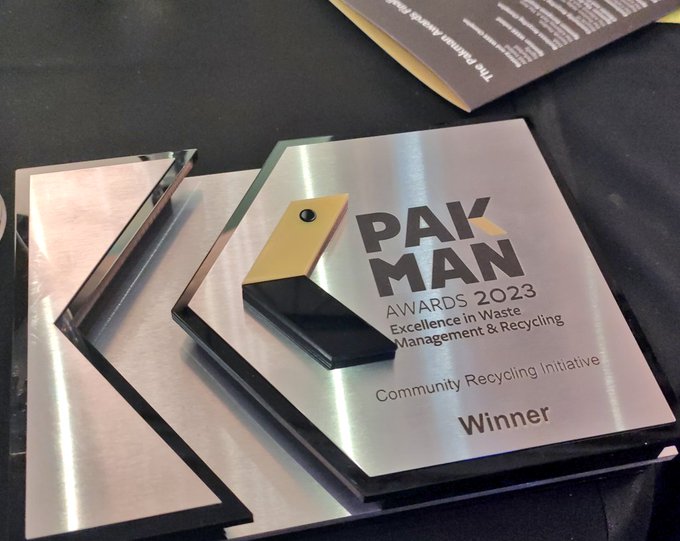
Recycle IT Pakman Award Winner 2023

Battery Recycling – Anytime is good!

How were doing? 

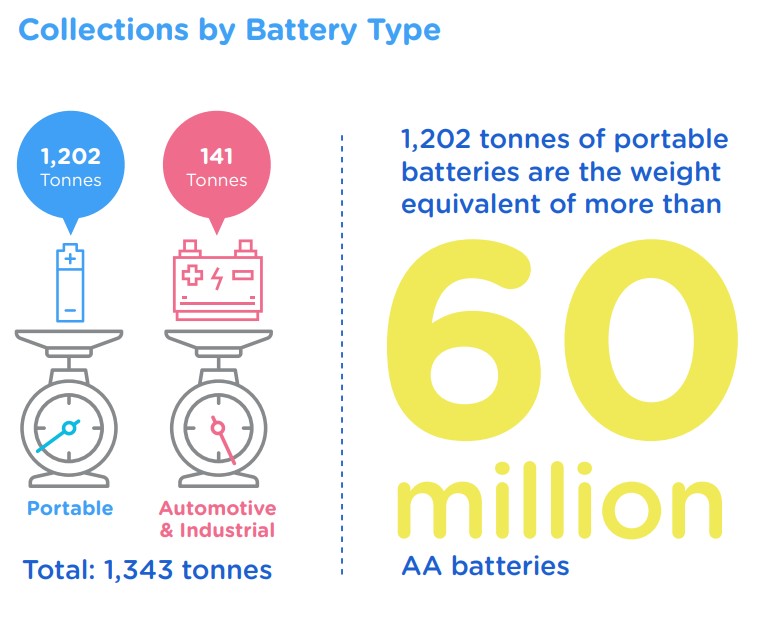
There was an estimated 60 million AA batteries recycled by householders in 2022 through retail drop-off points, civic amenity sites and at recycling center’s including Recycle IT – that is an average of 12 batteries for everyone in Ireland. (Source WEEE Ireland). This is great but we all can do more in 2023 especially with Christmas coming.

WEEE Ireland Battery Recycling Results 2022

Did you know?

Did you know some waste batteries are classified as hazardous waste and recycling is always the best option? For example

  • Batteries contain Sulfuric acid.
  • Flammable Gases: Hydrogen and oxygen are produced as a part of the operation of the battery.
  • Some batteries can cause electrical shock and burns if not handled safely
  • Don’t forget about the potential physical injury from the weight of the batteries packed together.

Ordinary household batteries used in a radio, remotes, kids, toys and other gadgets contain some chemicals so ideally should not be thrown in the green or black bin with your other types of waste. The same can be said for rechargeable batteries which also contain harmful materials.

The average alkaline AAA, AA, C, D, 9-volt or button-cell battery is made of steel and a mix of zinc/manganese/potassium/graphite, with the remaining balance made up of paper and plastic. Being non-toxic materials, all of these battery “ingredients” are conveniently recyclable at battery recycling points but not in your bin.

These are non-rechargeable and commonly found in household/offices items:

  1. AA (LR6) – Used in remotes, toys, flashlights, etc.
  2. AAA (LR03) – Used in smaller devices like remote controls, wireless mice.
  3. C (LR14) – Used in larger toys, lanterns, and musical instruments.
  4. D (LR20) – Used in large flashlights, radios, and some appliances.
  5. 9V (PP3 or 6LR61) – Used in smoke detectors, clocks, guitar pedals.
  6. CR2032 (coin cell) – Used in watches, car key fobs, calculators, motherboards.
  7. CR2025 / CR2016 – Used in similar applications as CR2032 (smaller capacity).

These can be reused hundreds of times:

  1. NiMH AA / AAA – Rechargeable alternatives to regular AA/AAA batteries.
  2. Li-ion 18650 – Used in flashlights, laptops, e-bikes (not typical AA-style).
  3. Li-ion 14500 – Same size as AA but 3.7V; used in high-drain devices.
  4. Li-ion 21700 – Used in newer flashlights and power tools.
  5. 9V Rechargeable – NiMH or Li-ion versions of standard 9V batteries.

Why recycle batteries?

Recycling electrical items and batteries helps reduce the number of items entering landfill and ensures any heavy metals and chemicals contained in batteries are managed in an environmentally responsible way.

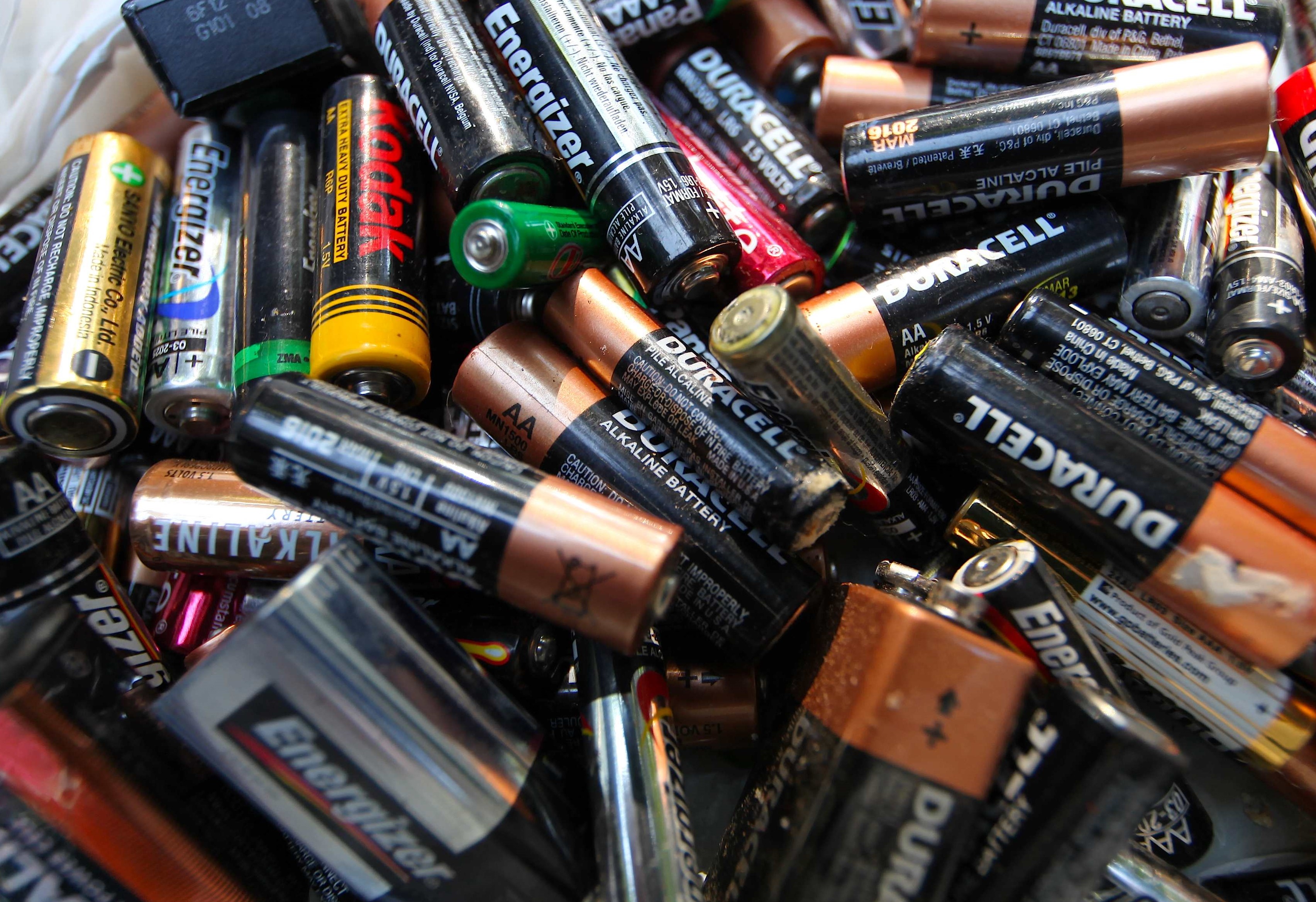
batteries-photo (2)
Waste Batteries – Recycle IT

Do something new!

It takes lots of energy to manufacture batteries that are simply disposable so why not save energy and other valuable resources including your money by trying rechargeable batteries and/or electricity-operated equipment instead of batteries. Rechargeable batteries are a more environmentally friendly option as they can last for several hundred charging cycles resulting in less waste being produced.

Where to recycle?

Thanks to EU Regulations implemented in 2008 it’s very easy to recycle your old batteries! According to the regulations, all retail outlets that sell batteries are now obliged to take back old batteries of a similar type.

Here are some options for recycling end-of-life batteries.

  • Chains of retail stores and shops where batteries are sold – Aldi and Lidl Ireland are leading the way!
  • Local recycling center’s accept old and waste batteries.
  • School all over Ireland works in partnership with WEEE Ireland to recycle waste batteries.
  • WEEE Ireland waste electrical and electronic equipment recycling days.
  • Recycle IT recycle batteries from businesses, homes, schools, colleges, and charities daily through our collection and drop-off services.

WEEE Ireland

In Ireland, the WEEE Ireland battery recycling scheme operates on behalf of producers of battery and electrical appliances. It aims to encourage people at home and at work to manage their electrical and battery waste responsibly.  Waste batteries can then be deposited in WEEE Ireland blue boxes at many locations across our country. Please find a list here

Eucobat is the European Association of National Collection Scheme for batteries. They assure that all waste batteries are collected and recycled in an ecologic way, and contribute this way to a better environment. WEEE Ireland promotes European Battery Recycling Week in September each year and has since 2015. Recycle IT support this week and make a great effort to increase batteries recycled. You might like to start planning a battery recycling event in your school, college or workplace!

Battery Recycling Week
Image: Eucobat – European Battery Recycling Week 

Recycle IT

Recycle IT works in partnership with WEEE Ireland to offer collections and drop off recycling services for old electrical, electronic and battery-operated equipment including batteries. The collection service is offered throughout Dublin and the surrounding areas and our teams are delighted to accept waste batteries as part of any recycling collection or simply drop them off at no cost.

To contact us please call 01 4578321, email us here or visit our website

Van 2020
Van with Recycle IT Logo

Free Summer Electrical Recycling in the Community

Here’s an opportunity 

Schools, charities, community groups, and small businesses are invited to recycle or host an electrical recycling collection at their location over the summer starting May 8th 2023.

This initiative aims to divert waste electrical and electronic equipment (WEEE) from offices and staff homes for recycling and is an opportunity to have a free WEEE from Work collection.

Mixed Electrical Equipment

Recycle IT – Recycling Electrical, Electronic, and Metal Items

The idea is to set up a temporary small WEEE collection point or containers in a central area of each school, community group or business to encourage recyclers to get into the habit of diverting more office and domestic electrical items away from the general waste bin.

Your colleagues, volunteers, students or project participants can easily take part. All you need to do is make people aware and reinforce the WEEE recycling message at every opportunity, then watch the container or box fill up.

Recycle IT will accept all types of electrical and pure metal equipment including older items once used and loved in the office, school classroom or canteen.

Close the Loop - Recycle IT
Close the Loop – Recycle IT

How it works

Our team can recycle all the old or unused small waste electrical and electronic equipment collected at your office in Dublin for “free” with Recycle IT. Once you let us know, our team will pick up full containers or boxes of old, damaged or unused electrical, electronic or pure metal items. Just email us quoting FREEMAYRIT

From experience, items will be small and medium size and found at home or in small offices. Click here to see a list.

Recycle IT Arrow - Recylcing Electrical Equipment in Dublin
Recycle IT – Recycling Electrical Equipment in Dublin

Success this Year!

Recycle IT want to say a huge well done to over 200 schools, charities and community groups who have already participated in WEEE recycling collections so far in 2023. We really enjoy working with you and ask that you spread the word to others!

School and community recyclers in 2023 include:

  • St.Decalns College, Dublin 7.
  • St. Christopher’s Primary School, Dublin 4.
  • Sophia Housing Association, Dublin 8.
  • Terenure College, Dublin, D6W.
  • FIT, Dublin 11.
  • Tuath Housing, Dublin 12.
  • Dublin Simon Community Dublin 20.

About Recycle IT

Recycle IT is an award-winning not-for-profit social enterprise providing a collection and drop-off service for all types of waste electrical, electronic and metal items. Recycle IT offer drop-off and collection services to both homes and organizations in Dublin and surrounding areas collecting a range of WEEE which includes thousands of printers and we can help recycle yours!

Our electrical community collection service is provided in partnership with WEEE Ireland. Recycle IT is supported by Pobal, South Dublin County Council and authorized by the National Waste Collection Permit Office and the local authorities across Leinster.

To speak with Recycle IT please call 01 4578321 or email us here

Visit our website www.recycleit.ie
Recycle IT are Awardees for 2023