Schools, charities, community groups, and small businesses are invited to recycle or host an electrical recycling collection at their location over the summer starting May 8th 2023.
This initiative aims to divert waste electrical and electronic equipment (WEEE) from offices and staff homes for recycling and is an opportunity to have a free WEEE from Work collection.
Mixed Electrical Equipment
Recycle IT – Recycling Electrical, Electronic, and Metal Items
The idea is to set up a temporary small WEEE collection point or containers in a central area of each school, community group or business to encourage recyclers to get into the habit of diverting more office and domestic electrical items away from the general waste bin.
Your colleagues, volunteers, students or project participants can easily take part. All you need to do is make people aware and reinforce the WEEE recycling message at every opportunity, then watch the container or box fill up.
Recycle IT will accept all types of electrical and pure metal equipment including older items once used and loved in the office, school classroom or canteen.
Close the Loop – Recycle IT
How it works
Our team can recycle all the old or unused small waste electrical and electronic equipment collected at your office in Dublin for “free” with Recycle IT. Once you let us know, our team will pick up full containers or boxes of old, damaged or unused electrical, electronic or pure metal items. Just email us quoting FREEMAYRIT
From experience, items will be small and medium size and found at home or in small offices. Click here to see a list.
Recycle IT – Recycling Electrical Equipment in Dublin
Success this Year!
Recycle IT want to say a huge well done to over 200 schools, charities and community groups who have already participated in WEEE recycling collections so far in 2023. We really enjoy working with you and ask that you spread the word to others!
School and community recyclers in 2023 include:
St.Decalns College, Dublin 7.
St. Christopher’s Primary School, Dublin 4.
Sophia Housing Association, Dublin 8.
Terenure College, Dublin, D6W.
FIT, Dublin 11.
Tuath Housing, Dublin 12.
Dublin Simon Community Dublin 20.
About Recycle IT
Recycle IT is an award-winning not-for-profit social enterprise providing a collection and drop-off service for all types of waste electrical, electronic and metal items. Recycle IT offer drop-off and collection services to both homes and organizations in Dublin and surrounding areas collecting a range of WEEE which includes thousands of printers and we can help recycle yours!
Our electrical community collection service is provided in partnership with WEEE Ireland. Recycle IT is supported by Pobal, South Dublin County Council and authorized by the National Waste Collection Permit Office and the local authorities across Leinster.
To speak with Recycle IT please call 01 4578321 or email us here
The reality is nearly everything in a laptop computer can be recycled yet only 13% of people in the EU recycled old desktop computers and and figure drops to 10% for old laptops or tablets. 33% of people living in the EU keep once oved laptops and tablets, at home after use rather than recycling.
With our recycling initiative, we try to promote reuse first, but most of the computers, laptops servers and communication equipment we deal with are years out of date and beyond repair and reuse. Many have been sitting at home or in offices for years, some have had parts removed or are damaged beyond recovery on arrival but all the equipment can be safely recycled.
Laptops for Recycling
How a standard PC can be recycled:
Keyboards, mice, and other computer accessories are usually made of plastic and are recyclable. The plastic goes through a shredding process and is then sold on the commodities market as mixed plastic scrap.
Some recyclers use optical sorters that create a very clean stream of plastic, with minimal metal contamination. Usually, the plastic is further purified and compounded with virgin plastics and pelletized. This pelletized resin can then be used as a recycled-content plastic.
For example, Recycle IT operates in a supply chain where plastic is processed for reused – to make new parts – a process that has a smaller carbon footprint, lighter environmental footprint and can deliver a cost saving over manufacturing from new materials.
Computer and Laptops
Chassis/Base – these materials are primarily made of metal (PC Chassis) or what’s known as PC/ABS plastics, which are recyclable. Some laptops also feature carbon fibre mixed with polycarbonate plastics to keep the base cool to the touch. This material is not currently widely recycled, but it can be used in waste-to-energy processes.
Printed Circuit Boards (PCBs), processors, and memory – these are made of multiple types of plastics, fibreglass and precious metals that can be recycled. Scrap copper, precious metals like gold, and some other non-ferrous metals are commonly recovered from computer circuit boards and other components.
Personal Computer System Boards
Once these materials have been sorted out they go through more specialized processes, e.g., circuit boards first into copper recovery, followed by specialized refining of the residues to recover other metals. These processes are usually accomplished through smelting or sometimes through hydro-metallurgical processing via acids or cyanide compounds in order to recover gold and other precious metals.
Batteries – when computers and laptops come into our facilities, the battery is removed from the system manually. Once removed, batteries are separated, packaged safely, and sent for recycling. Once they reach their destination, the plastic casing is manually separated while the rest of the material is refined through a thermochemical process at high temperatures to separate various materials). The result is a metal alloy and a stony waste material separated from metals during the smelting: the metal alloys are further treated to recover cobalt, nickel, copper, and iron; lithium is typically concentrated in the stony waste material and is often recovered.
Computer cables
Cables – wire and cable that is not damaged can be reused directly. The high-grade copper can also be recovered by manually removing insulation with simple tools or by chopping wire into small pieces. After arriving at a specialised facility they undergo a hydrological process in which the small pieces of insulation float while the copper sinks. Unfortunately, the plastic insulation from the wire-chopping process is very hard to recycle and is usually sent to a waste-to-energy facility.
Screens – many manufacturers have stopped using mercury and arsenic in flat panel monitors making it easier to recycle display panels at their end-of-life. The recycling approach for LCD panels involves the separation of the glass substrate, polarizer foils, and the elements indium and copper into individual outputs. This process is carried out in Ireland, and we are delighted to be able to supply screens for safe recycling,
IT Equipment
Fans – made of plastics and metals, which can be separated and recycled.
Other parts – there are other things that go into your computer, like screws, springs, small plastic parts, etc. and they are generally made from the materials above, making them mostly recyclable. They typically make up only a small portion of the overall product.
Packaging – As part of recycling we receive a lot of corrugated cardboard, as well as other materials like plastic bags and creates. We try to reuse these items; we bale cardboard for reuse but some of the materials can’t be reused at present and are sent for heat recovery through incineration.
In support of Recycle IT – please recycle old, unused electronics. It helps the environment with reuse, reduces the mining of new raw materials and creates training and employment for people returning to work after an absence.
About Recycle IT
Recycle IT, is a social enterprise offering electrical, electronic and metal recycling services through drop-off and collection. Services are provided in partnership with WEEE Ireland and South Dublin County Council. Recycle IT is supported by Pobal and Dormant Accounts and authorized by the National Waste Collection Permit Office and the local authorities across Leinster.
In 2024, there was a 75% surge in small electrical device sales in Ireland, driven by vapes and solar panels, leading to 93 million household items sold, a massive increase from 2006. Despite this growth, 84% of Irish households reported hoarding an average of 15-20 unused electrical items, and one in eight people admitted to disposing of small items in general waste bins (Source: WEEE Ireland and ERP)
That is a lot of old unused phones which could be recycled for good and with the festive season around the corner there will be lot more old, damaged or unused small electrical items which can be recycled
Using and Replacing
As technology at home and in the office evolves, the speed at which people cease using their existing small electrical and electronic items and replace them with newer models happens with increased regularity. Days like Black Friday and Cyber Monday and gifting for Christmas increase exposure to new gadgets and drive consumers to purchase!
Small Mixed Electrical/Electronic Item – Recycle IT
What is Small?
Individuals young and old replace mobile phones, modems, toys, game consoles, chargers, virtual assistants (AI technology), smartwatches and fitness monitors without thinking too much about the older equipment. Did you know the average life of a smartphone and smartwatch is approx? 24 months.
There are reasons for a short life such as built-in obsolescence or the consumer’sperceived need or want for the newest product. Research by the German Environment Agency on the lifespan of consumer electronics can provide further information; just click here.
Small Household Electrical Items – Recycle IT
Before you dispose of old items please be aware many items contain valuable metals and plastics. With natural resources in limited supply, combined with ever-increasing waste disposal costs, it’s important that we safely recycle small electrical items so that they can be reused in new products.
Small Electrical Equipment List
Items like those listed above and below (if not fit for reuse) are usually shredded to reduce volume and are mechanically separated into their component parts (plastics, ferrous metals and non-ferrous metals). The materials collected will then be reused. For example, mixed-grade plastic can be used to make street and park furniture or multi-purpose decking. Any metals recovered are reused in the manufacture of many different types of new products including your new phone or tablet!
Small Electrical Equipment List (Continued)
What to do?
Recycle IT can help you recycle your small, old, unused or damaged electrical items including batteries of all types. Pop your batteries in a small clear bag alongside items like kettles, toasters or small electric tools and they all will be safely recycled. Please don’t place them in the black, brown or green bin or leave them out for unauthorised collection.
Small Electrical Jukebox – Recycle IT
Recycle IT want to encourage all users of electrical items to recycle their unwanted, damaged, broken or outdated small electrical gadgets when recycling large items from their homes and offices. Clear out draws, shelves and bags used to store smaller items out of sight!
Recycle IT offer a community collection service, a business collection service and free drop-off to communities across Dublin and would like to see an increase in the amount of small electrical items received for safe recycling. If this does not work for you, simply place it in an envelope or small box and post it to us!
Please don’t horde items in the hope of future repair for reuse. Please do get items repaired quickly and if not please recycle!
For full lists of items that can be recycled by Recycle IT click here. (PFD files can be viewed or downloaded)
About Recycle IT
Recycle IT is an award-winning social enterprise providing a community, personal and business collection service for all types of waste electrical and electronic equipment (WEEE) in Dublin and surrounding counties.
During 2022 Recycle IT offered to drop off and collection services to thousands of homes, schools, charities and businesses across Dublin and surrounding areas collecting a range of WEEE which includes thousands of computers, cables, monitors, microwaves and screens
Recycle IT services are provided in partnership with WEEE Ireland. Recycle IT is supported by Pobal, Dormant Accounts, South Dublin County Council and authorized by the National Waste Collection Permit Office and the local authorities across Leinster.
For more information about Recycle IT please visit www.recycleit.ie or call 01 4578321.
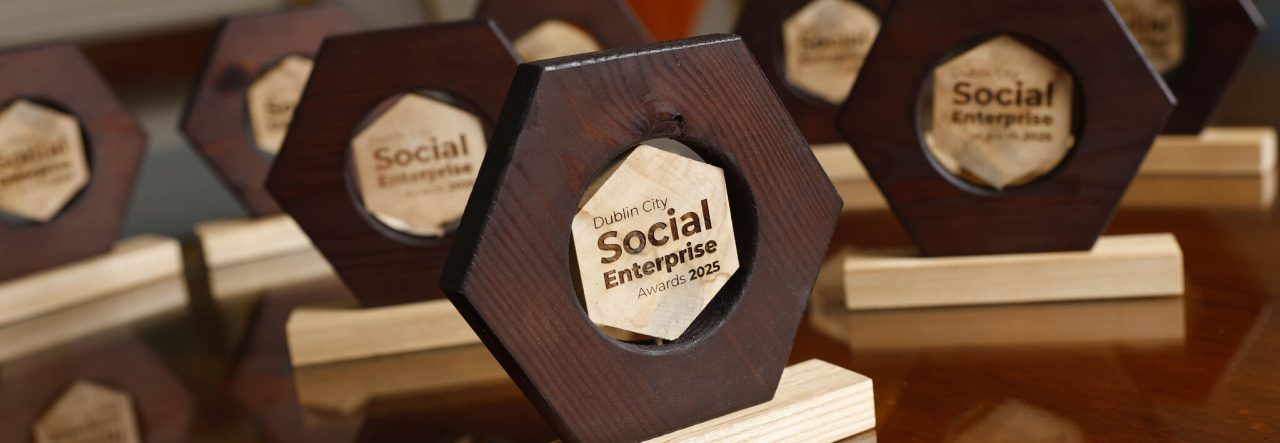
Recycle IT – Dublin City Social Enterprise Award Winner 2022
Did you know that multinational Hard Disk Drive producers Seagate and Western Digital share over 85% of the market? Correspondingly, the growth or decline in hard drive shipments for desktops and laptops by both Seagate and Western Digital are closely related to global desktop and laptop sales.
Worldwide PC shipments totaled 68 million units in the third quarter of 2022, a 19.5% decrease from the third quarter of 2021, according to preliminary results by Gartner, Inc. This is the steepest market decline since Gartner began tracking the PC market in the mid-1990s and the fourth consecutive quarter of year-over-year decline.
Data Safety on Office Computers
The Europe, Middle East and Africa (EMEA) PC market decreased 26.4% year-over-year in the third quarter, reaching 17 million units – the steepest decline among all regions. This is the third negative quarter for the EMEA PC market following a boom at the start of the pandemic.
“Multiple factors led to significant deterioration in the EMEA PC market, including challenging macroeconomic conditions, declining business and consumer demand and high levels of inventory,” said Kitagawa. “Additionally, many PC vendors shuttered operations in Russia in the first two quarters of this year, which negatively impacted overall shipments and is particularly visible across year-to-year comparisons.”
Statista report, In 2021, global unit shipments of hard disk drives (HDDs) fell to 258.9 million units, a 2% fall from the 260.3 million units shipped in the previous year. People are still buying a lot of storage.
Hard Disk Drives – Recycle IT
Creating Data
Even with PC sales slowing we are all still large consumers of information and we’re buying lots of electronic equipment which includes hard disk drives (HDD) to store business and personal customer data including photos of everything from our kids to bank statements and passwords.
Did you know that 90% of the data on the internet has been created since 2016? This is according to an IBM Marketing Cloud study which suggests individuals, organizations, and devices have all become data creators who are turning out vast amounts of information to the internet daily.
Storage
Today data can be stored on computers, game consoles, external hard drives, mobile phones, tablets, memory cards, memory keys or many other storage devices. Both business and personal data are stored and can be valuable to others. Information like credit card information, photos, email addresses, passwords, address details, medical history and much more.
So if you are upgrading to a new computer device (desktop computer, phone, laptop, tablet, etc.) please arrange for the removal of the hard drive at the same time as recycling the computer!
It’s important to remain mindful of removing, erasing and destroying data which is important to you.
Hard Disk Drives for Destruction – Recycle IT
What to Do next?
The key to destroying your computer HDD is ensuring the drive can’t ever spin again. The physical destruction of the drive means increased confidence that stored data is obliterated and can never be used again. This is the method to Recycle IT practice.
In the interest of time and money, you don’t need to destroy the full PC or laptop, just the hard disk drive (HDD) which is a small box inside of a computer, server or laptop.
How to Destroy Hard Disk Drives
If you are disposing of an old computer with a hard drive, it’s best to physically destroy the hard drive just to be 100% certain that the old data is completely destroyed.
Recycle IT use trained personal and electronic tools to ensure the HDD is physically destroyed. This method is an ideal option for the disposal of home or office hard drives.
Hard Disk Drive – Recycle IT
Safety in Destruction
Our team takes every precaution from wearing protective goggles, gloves, and a dust mask for the mouth and nose when cutting into the metal drive. They can cut right through the drive, from one side to the other multiple times ensuring the platters and the controller board are shattered. Recycle IT can also provide destruction and disposal certification depending on your needs.
Finally
No matter who or what method you choose, it’s best to arrange the destruction of old hard drives containing important information before or at the time of recycling your computers, laptops, phones, etc. Recycle IT offer the service and the opportunity to view the destruction process.
About Recycle IT
Recycle IT is an award-winning, not-for-profit, social enterprise established to create employment and promote environmental awareness through recycling and reuse. We work in partnership with WEEE Ireland and are authorized by your local authority to provide electrical, electronic and pure metal recycling collections across Dublin since 2007. Recycle IT are fully compliant for WEEE collection with permit detail available here.
To speak with Recycle IT please call 01 4578321 or email us here
Waste Electrical and Electronic Equipment (WEEE) recycling is an important consideration for every business, including small and medium-sized companies and especially those with a lot of electronics accumulated over a long period. Equipment can include computers, laptops, tablets, phones, networking equipment, printers, batteries, and other office devices like heaters, kettles, coffee machines and microwaves.
Some of these old and unused items may be stored in desk drawers or stationary rooms and years out of use. The safe disposal of old, damaged, or unused equipment is essential to good environmental practice in your business.
Related equipment including cables, chargers, servers and communications racks can also be recycled safely, Recycling can involve disconnecting power, removing data drives safely and securely, handling components carefully, separating recyclable materials, and following environmental regulations. Proper disposal reduces waste, protects sensitive information, and supports sustainable resource recovery practices.
Electronic Equipment Racks for Recycling
Some Background
According to the United Nation’s Global E-Waste Monitor, e-waste is the world’s fastest-growing domestic waste stream. Its disposal contributes to climate change due to the chemicals released when it gets burned. Furthermore, 10 % of all electricity consumption and 4 % of all carbon emissions worldwide stem from the ICT industry.
E-waste is hazardous because the components used to make devices contain metals and chemicals known to harm human health. Adults and children in developing countries often work, live, and play in or near e-waste recycling centres and are therefore especially vulnerable.
The report foresees a drop in the documented collection and recycling rate from 22.3% in 2022 to 20% by 2030 due to the widening difference in recycling efforts relative to the staggering growth of e-waste generation worldwide.
Challenges contributing to the widening gap include technological progress, higher consumption, limited repair options, shorter product life cycles, society’s growing electronification, design shortcomings, and inadequate e-waste management infrastructure.
Disposal of Electronic Equipment
Why We Do
Recycle IT safely recycle Waste Electrical and Electronic Equipment Recycling for business. We offer a collection service for all types of electronic equipment. Many items are broken down into their component parts and salvaged components that can be reused including the metal from outer casings. This is a much more practical solution for the growing challenge of e-waste. Simply dumping the equipment in the bin is not the right thing to do.
Before the safe disposal of business computer equipment, Recycle IT can on request offer data destruction to ensure that sensitive information is not stolen and used for fraud – an important and often legal consideration for many companies. Just ask in advance of drop off or the collection and the service can be arranged.
Computers including Hard Disk Drives
Recycle IT aims to support the Circular Economy which favour designing products for durability, reuse, remanufacturing, and recycling. It aims to keep materials circulating for as long as possible. It’s an economy that encourages many different uses for materials instead of just using them up and throwing them in a landfill or an incinerator.
Our recycling initiatives have led to positive recognition from several sources, including Repak Ireland, Dublin City Council, Rethink Ireland, and others. Please click here to learn more.
If your business needs to free up space, declutter and safely recycle old electronic equipment or pure metal items please do contact Recycle IT via email or telephone at 01 4578321
About Recycle IT
Recycle IT, is an award-winning Dublin-based, not-for-profit, social enterprise offering electrical, electronic and metal recycling. Services are provided in partnership with WEEE Ireland. Recycle IT is supported by Pobal, the Dormant Accounts Fund, and South Dublin County Council. Recycle IT is authorised by the National Waste Collection Permit Office and the local authorities across Leinster.
For further details about our free and cost-effective services call us on 01 4578321, email info@recycleit.ie or visit the Recycle IT website at www.recycleit.ie
We are all using cables daily, we replace them, have spares and get new cables with most new electronic items purchased. The global wires and cables market is projected to be worth $200 billion in 2022 and grow to $294 billion in 2029. Source: Fortune Business Insights. From these figures alone we can see electrical, and electronic cable is a growth area.
Today, recycling and recovery of valuable metals from all sorts of waste equipment including electrical and electronic items is a normal enough occurrence. We are all familiar with recycling and recycling centres and the need to segregate electrical equipment including cables from other types of household or office equipment for recycling.
Some of the main reasons for segregating items for recycling relate to the circular economy, climate change, global warming and reducing mining of raw materials to make new items such as phone charger cables. It also ensures reusable items don’t go to landfills or for incineration.
Mixed Computer Cables for Recycling – Recycle IT
Everyday Wires and Cable
A wire is a single electrical conductor while a number of wires bundled together are called a cable. Cables are a feature of everyday life and are an essential part of electrical and electronic equipment. They mainly consist of plastic covering, aluminium (Al), and copper. Cables are usually recycled once the electronic equipment they relate to, has reached the end of their useful lives.
If you have cables of any type including, electrical, phone, internet, power or charger cables they can be recycled safely at a recycling centre alongside other small electrical items.
Whatever you do, cables, wiring, and chargers should never go in the waste bin or green bin. They contain metals like copper that make them hazardous waste if they’re put in the bin. Some cables and wire can be long and stringy, like outdoor lights, office cabling, and simply wire coat hangers but all can cause havoc for collection equipment and recycling staff when not disposed of correctly.
Cables for Recycling – Recycle IT
Reusing Cable
Sometimes, phone and computer chargers can be reused for a different device than the one they came with. So before buying a new charger, see if you have any old ones that will fit. You can also sell cables for reuse or upcycle cable and wire for craft items or homemade and unique jewellery like rings or broaches. Please do ensure plastic and PVC covering once removed are recycled safely.
Recycling Cable
For some, the recycling and recovery process involves burning the plastic that covers the wire in order to recover the copper and aluminium. This method is extremely harmful to the environment since it releases toxic gases. Please ensure your cable does not end up on fire.
Generally, safe cable recycling works with dry cables with copper or aluminium conductors. The insulation is made of plastic, rubber, or paper with many power cables having, steel or lead armouring for additional safety. These cables can be processed in a cable stripper prior to being downsized into bulk metal and plastic granules which are both reused to make new equipment.
Plastic Granules recovered from Cables
When you recycle anything with a power cable, plug or a battery you are helping to reduce the amount of waste going to landfills. Electrical items generally contain hazardous components and therefore need to be disposed of correctly. By recycling, you help with the reuse of plastics, glass and metals as they are recovered for use again in manufacturing.
It’s easy to check if an electrical item, toy or game is recyclable if it reached the end of its working life. Simply ask the following questions and if the answer is yes, to any of these, it is recyclable: Does it have a plug? Does it use batteries? Does it need charging? Does it have a picture of a wheelie bin crossed out?
About Recycle IT
Recycle IT, is an award-winning social enterprise offering electrical, electronic and metal recycling services through drop off and collection. Recycling services are provided in partnership with WEEE Ireland and South Dublin County Council.
Recycle IT is supported by Pobal and Dormant Accounts and authorised by the National Waste Collection Permit Office and the local authorities across the east midlands waste region.
Our goal is to create training and employment opportunities through the provision of waste management services.
An uninterruptible power supply (UPS), provides backup power when your regular power source fails or voltage drops to an unacceptable level. A UPS is also known as a battery backup. Although UPSs are not truly IT equipment they play an important part in ensuring reliability. UPSs ensure a flow of high-quality power to critical IT equipment.
Old UPS Devices for Recycling
Using UPS Equipment
A UPS is not intended to provide long-term backup or extended use of connected devices for periods without power; UPS units are not designed to offer a battery-operated solution for continuing to work, use the internet, or operate your business.
Multiple devices can be plugged into a UPS similar to a power bar, and the UPS generally provides such functions as power surge protection. When a drop in voltage occurs, the UPS detects it and switches over to battery backup. Components plugged into the UPS can then receive power for a limited amount of time (often ranging from 10 to 45 minutes), until normal power is restored or the system can shut down properly.
UPS equipment can be found in offices and now homes as many more people work from home. It with noting, that over time UPS devices and internal batteries need to be replaced while older UPS units should go for safe recycling.
Your IT team or IT contractor should be able to offer guidance on when you need to replace batteries or the complete UPS device.
Different Types of Power Supply Batteries
There are three main types of batteries used in power supplies: Nickel-Cadmium, Lead-Acid, and Lithium-Ion. There isn’t a single “best” UPS battery technology – the choice should be made on a your requirements for a project. All can be recycled safely.
Recycling UPS Equipment
Alongside all type of IT equipment Recycle IT manage the safe collection, breakdown and disposal of UPS equipment, batteries and replacement UPS batteries in line with waste regulations.
UPS Breakdown
As a registered waste collector and permit waste facility our service helps ensure that all the legal requirements associated with the collection, transportation and disposal of waste batteries and electronic components are fully complied with.
The majority of UPS systems for recycling are older systems with at least ten years of usage. Those sent for recycling are replaced by higher efficiency and more compact systems. Uninterruptible power supplies are generally stripped down within our facility into their subassembly parts. Metals and plastics are recycled, including electrical cabling, capacitors and fans. PCBs and components are recycled safely and in accordance with national guidelines covering WEEE and RoHS.
Batteries from UPS equipment
For more information about our ups battery recycling service, please contact a member of our team @ info@recycleit.ie
More About Recylce IT
Recycle IT is a Social Enterprise providing employment and training through recycling opportunities. We offer recycling drop off and collection services in Dublin and surrounding areas.
In 2021 our team help recycle 652 tons of waste electrical, electronic equipment and metal. This includes business IT equipment, commercial equipment and domestic household appliances.
Recycle IT worked with individuals, resident associations, charities, schools, government organisations, community groups and businesses to provide safe electrical recycling services to those with differing needs and budgets.
As we all start to get back to our new normal living and working with COVID 19 we will once again arrange and book business, community, sport, and family events including formal meetings and social occasions.
It’s important to look at environmental considerations when arranging these types of events and occasions. By proactively working with service providers, we all can minimise environmental harm and achieve greater environmental wellbeing.
A green meeting incorporates environmental considerations at all stages of the meeting or event to minimise the negative impact on the environment and positively contribute to host communities. (Green Meeting Industry Council).
Meeting Coffee Break
Failte Ireland
Failte Ireland has developed a guide to help organisations and communities start on the road to running green meetings or events, large and small. These meetings and events will incorporate environmental considerations throughout all the various stages to minimise the negative impact on the environment and positively contribute to the community hosting the event or meeting.
This Failte Ireland guide is intended for any business involved in planning and/or running a meeting, conference, or event in Ireland. This will range from conference organisers, venues (including hotels), accommodation providers, catering companies, entertainment/activity providers, audiovisual/IT companies, and transport providers. The guide was prepared to allow businesses to start or continue the road to planning and running green meetings and events.
The document is a voluntary guide, and not a standard. (Click below to access).
What to Ask?
As an individual or organisation wishing to book a meeting or event, you might ask the following questions of a service provider.
Please don’t feel awkward when asking these questions, the best organisation will have no problem answering and others will learn!
Do you have an environmental policy?
I want to run a carbon neutral event; can you help me do that?
What are your company’s sustainability principles?
We take Corporate Social Responsibility very seriously in our company and we want to work with businesses that do the same. Is that you?
Why should we choose your company?
What makes you environmentally sustainable?
According to the United Nations (UN) World Commission on Environment and Development, environmental sustainability is about acting in a way that ensures future generations have the natural resources available to live an equal, if not better, way of life as current generations.
Eco-Friendly Early Morning Meeting
Service Providers
Conference, meeting, and events venues can look to this Failte Ireland business tool for guidance on how best to address potential customer questions on arranging eco-friendly meetings and events for potential customers.
With an ever increasing focus on the environment across the world, it is not surprising that the meetings, conference and events sector has come under scrutiny, in respect of what actions it is taking to add to the ever growing demand for sustainability.
To get a copy of the guideclick here. Meeting and event organisers and operators will benefit from taking a look!
About Recylce IT
As part of an environmental policy and ongoing sustainabily organsations should have a procedure for dealing with its old electronic, electrical and metal equipment once it’s served it’s purpsoe.
Every part of the meeting, conferencing and hospitality sector used electronic, electrical, and metal equipment to meet the needs of customers. Once this equipment has reached the end of its first life it might be offered for reuse and if not fit for reuse it should be safely recycled.
Recycle IT is an award-winning, not for profit, social enterprise established to create employment and promote environmental awareness through recycling and reuse. We work in partnership with WEEE Ireland and are authorized by your local authority to provide electrical, electronic and pure metal recycling collections across Dublin and surrounding areas since 2007. Recycle IT are fully compliant for WEEE collection with permit details available here.
To speak with Recycle IT please call 01 4578321 or email us at here
Recycled electrical waste increased by 10% in 2020?
WEEE Ireland reported that the amount of electrical waste recycled at local authority recycling centres rose by 10% last year. This is the equivalent of about half a million small household appliances like kettles, toasters, blenders, batteries, cables, rice makers, sandwich toasters and more!
WEEE Ireland say this increase demonstrates how behavior and attitude of Irish people towards recycling e-waste is improving. (WEEE = Waste, Electrical and Electronic Equipment).
What’s changed?
In 2021 something changed. There was a spike in the number of electrical items dumped in general waste bins which resulted in a 7% decrease in electrical recycling compared with January 2020. This maybe the result of COVID 19 travel restrictions imposed in January 2021 or something else?
Mixed System Boards for Recycling
Leo Donovan, chief executive of WEEE Ireland, said: “Unfortunately, in January we saw a reverse in that behavior, and we would ask people to seriously consider the danger and environmental impact of getting rid of e-waste in household bins.
Mr. Donovan, also ask people to seriously consider the danger and environmental impact of getting rid of e-waste in household bins. “We need people to support a transition towards a more circular economy, which aims to keep our resources in circulation for longer.”
Recycle IT as an e-waste recycling service provider wishes to encourage Irish people to recycle safely and not place electrical items in any one household bin. Not even the green bin!
Old TV Screen for Recycling
It’s great to see people safely recycle old electrical waste at a bring centre or colleciton day. These efforts will reduce exposure to toxic and hazardous substances found in many types of electronic equipment, If not recycled correctly everyday electrical equipment poses a real risk to human health and the environment.
For Ireland to comply with EU targets, e-waste recycling will need to increase by more than 10% in 2021. (Over 2020 figures) This will help Ireland to stay in touch with the ever-increasing amounts of new electrical items appearing on the market and in homes each year. These new items usually replace older or damaged items which can and should be recycled if not fit for repair and/or reuse.
Interesting research
The world generated 53.6 million tonnes of e-waste in 2019 which is an increase of approx. 9.2 million tonnes in five years.
After reviewing 30 years of recorded data The World Economic Forum reports that e-waste volumes in the U.S. is decreasing. U.S. households now produce about 10% less electronic waste by weight than they did at their peak in 2015. This can also be seen in other developed countries including Ireland.
The Recycle IT team say “new electrical and electronic products are much lighter and more compact than past products, This means less weight per item but lot more items to handle and recycle”.
Mixed Computer Parts for Recycling
Smartphones and laptops have replaced desktop computers. Flat screens have displaced bulkier TV and monitors, streaming services are doing the job that once required standalone MP3, DVD and Blu-ray players. U.S. households now produce about 10% less electronic waste by weight than they did at their peak in 2015.
This is a positive but also a negative with many smaller e-waste items ending up in household bins. If your electronic items get damaged, repair specialists can be difficult in find and costly compared to new items. Some personal electronic equipment is almost impossible to repair due to the small size, e.g. Bluetooth earbuds. The EU is looking at repair and encouraging producers to make it easier and less costly. We await an outcome!
About Recycle IT
Recycle IT provide recycling opportunities to home and business customers for all types of electronics equipment. Recycle IT offer a range of services including free, drop off, free community collections and cost-effective personal or business collections.
Our team will accept old household electrical items, small office electrical items alongside your garden power tools and pure metal equipment. We can also accept commercial appliances but do call in advance.
Recycle IT as a social enterprise works in partnership with WEEE Ireland. Recycle IT are supported by Pobal, South Dublin County Council and authorized by the National Waste Collection Permit Office.
To learn more about recycling electrical equipment please call Recycle IT on 01 4578321, email us or visit www.recycleit.ie
Recycle IT – Repak Award Winner 2019 – WEEE Champion
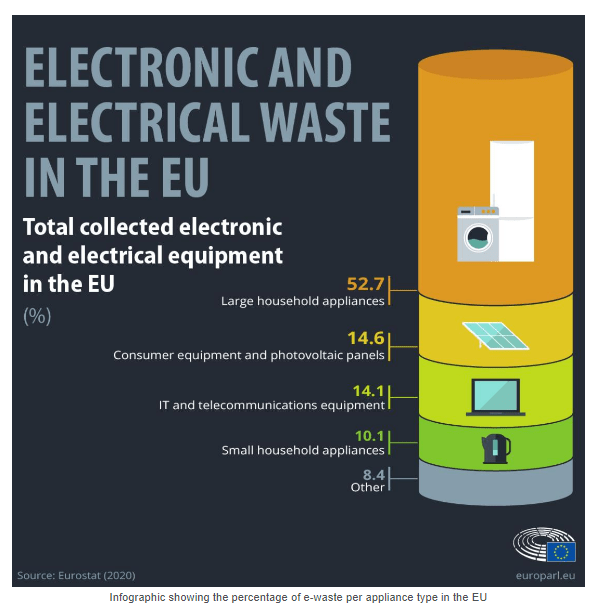
We are sharing a news article from the European Parliament, a forum for political debate and decision-making at EU level. This particular article was published on 23 December 2020 and is about electrical and electronic waste and the fact that it growing faster than any other waste stream. Check out the facts and figures in the infographics below.
Did you know that less than 40% of e-waste is recycled. Electronic devices and electrical equipment define our modern life. From washing machines and vacuum cleaners to smartphones and computers, it is hard to imagine life without them. But the waste they generate has become an obstacle in the EU efforts to reduce its overall ecological footprint. This includes Ireland.
What is e-waste?
Electronic and electrical waste, or e-waste, covers a variety of different products that are thrown away after use. From the largest items to the smallest including cables, phones and batteries. Large household appliances, such as washing machines and electric stoves, are the most collected, making up more than half of all collected e-waste.
This is followed by IT and telecommunications equipment (laptops, printers), consumer equipment and photovoltaic panels (video cameras, fluorescent lamps) and small household appliances (vacuum cleaners, toasters, kettles etc.).
All other categories, such as electrical tools and medical devices, together make up just 7.2% of the collected e-waste.
E-waste recycling rate in the EU
Less than 40% of all e-waste in the EU is recycled, the rest is unsorted. Recycling practices vary among EU countries. In 2017, Croatia recycled 81% of all electronic and electrical waste, while in Malta, the figure was 21%. Ireland recycles 47.7% of all electronic and electrical waste but this figure could be a ;ot higher if we all did more.
Why do we need to recycle electronic and electrical waste?
Discarded electronic and electrical equipment contains potentially harmful materials that pollute the environment and increase the risks for people involved in recycling e-waste. To counter this problem, the EU has passed legislation to prevent the use of certain chemicals, like lead.
Many rare minerals that are needed in modern technology come from countries that do not respect human rights. To avoid inadvertently supporting armed conflict and human rights abuses, MEPs have adopted rules requiring European importers of rare earth minerals to carry out background checks on their suppliers.
What is the EU doing do reduce e-waste?
In March 2020, the European Commission presented a new circular economy action plan that has as one of its priorities the reduction of electronic and electrical waste. The proposal specifically outlines immediate goals like creating the “right to repair” and improving reusability in general, the introduction of a common charger and establishing a rewards system to encourage recycling electronics.
To learn more and read the post from the European Parliament please click here.
If you need to recycle electrical or electronic equipment safely Recycle IT are happy to help. Just send us an email or call 01 4578321 for more details.
Recycle IT is a not for profit, social enterprise based in Clondalkin, Co Dublin, Ireland.
Recycling allows materials to be reused, re-purposed, recycled and recovered over and over. Waste sent to landfill sites and incinerators does not drive reuse and costs Irish taxpayers, millions of euros every year. Yet much of this cost and waste could be saved by recycling.
Waste of all types produce emissions of greenhouse gases including methane, a powerful greenhouse gas which contributes to climate change and after the severe weather events and natural disasters over recent years, we can all see the effects of this change first hand.
School Climate Strike – Photo credited to Christian Aid Ireland
Targets
Ireland has committed to a legally-binding EU target. This means reducing greenhouse gas emissions coming from agriculture; transport, residential buildings, commercial activity, “non-energy intensive industry” and waste including incineration.
Ireland is obliged to cut its emissions in total by 80% by 2050 compared to 1990 levels, under its Climate Action and Low Carbon Development Act 2015. In 2017 the Irish Government published a National Mitigation Plan explaining how it intended to meet that goal.
The then Minister for Communications, Climate Action, and Environment have said that it is likely to cost the State up to €150 million to pay for carbon credits to compensate for the fact that Ireland will fail to meet its 2020 greenhouse gas emissions and renewable energy targets.
Energy consumption accounted for 60% of Ireland’s greenhouse gas emissions in 2017. Transport, residential and industry accounted for the highest shares of emissions. (Source SEAI). As our economy grows these emissions are likely to increase further.
Climate Change Ireland
The 2018 report from Climate Action Network (CAN) Europegives Ireland a total score of 21 % on fighting climate change, making it one of the only three EU countries that scored less than 30% along with Estonia (24%) and Poland (16 %). (Source: Green News Ireland).
Recent Judgment
On July 31st 2020 the Irish Supreme Court ruled that Ireland as a nation needs to strengthen it’s Climate Action Plan (CAP) published in 2019. In a case brought by Friends of the Irish Environment (FIE), they argued that the plan was not “fit for purpose” because it was not designed to achieve substantial emission reductions in either the short or medium-term.
Clodagh Daly, a spokesperson for Climate Case Ireland, described the judgment as “really significant”. “The unanimous ruling by seven supreme court judges has made it crystal clear that the Irish Government cannot set long-term commitments without showing how they will be achieved in the short term,”
Climate Action Plan 2019
Eamon Ryan (TD) and current Irish Government’s Minister for Climate Action, Communication Networks and Transport, welcomed the judgment and congratulated FIE for taking the “important” case.
The government now must set real actionable targets. Please click the image above to download a copy of the Climate Action Plan 2019.
Help by Recycling
Ireland’s apparent inability to meet its obligations for emissions reduction is cross-sectoral with some sectors of society simply doing little to help. Fixes such as increased working at home and eco-friendly public transport will happen but immediate action can be taken by simply by reducing, reusing or safely recycling items from around your home, school, warehouse, store or office. (really think about what to do with old stuff and do you need new stuff).
In a number of areas in Dublin, the local authorities work in partnership with Recycle IT to offer residential collections for electrical and electronic waste.
This free collection service is usually an annual service offered too or requested by residents groups in Dublin and surrounding areas. The service really helps people safely dispose of large and small electrical, electronic and metal appliances and equipment.
Recycle IT – Recycling Helps
Household collections are held on an agreed and specific day or week. Your resident’s association will notify you of your collection day usually 3 – 5 days in advance with a message via whats app or text with further reminders a few days before collection.
You can also contact us if unsure if the item you have for recycling will be accepted as part of collection Just email Recycle IT directly
Some Household Recycling Guidelines
When putting items out for a recycling collection remember:
to keep the piles tidy inside your garden, or on the curb so the footpath or roadway is kept clear
If you think an unofficial collection is taking place, call us and we will arrange a collection from your door
if in an office move items to the ground floor to allow for speedy collection
let us know if items can’t be easily and safely lifted by two collection team members?
notify us in advance if items need to move out of your home. (we can offer some guidance based on Covid19 best practices).
notify us in advance about sharp or dangerous objects.
keep items secured if severe weather is expected.
Recycle IT also support business customers with cost-effective recycling options. We collect and recycle all types of office equipment from the office kitchens to electronic items used on the office desk.
About Recycle IT
Recycle IT, is anaward-winning nonprofit social enterprise offering electrical, electronic and metal recycling services through drop off and collection. Services are provided in partnership with WEEE Ireland and South Dublin County Council.
Recycle IT are supported by Pobal and Dormant Accounts and authorized by the National Waste Collection Permit Office and the local authorities across Dublin, Kildare, and Wicklow. For more information on Recycle IT please call 01 4578321, email info@recycleit.ie or visit our website www.recycleit.ie
Advanced hardware and software on computers, laptops, tablets, and smartphones help quickly make IT equipment go out of date. The United Nations University (UNU) found that more than 44 million metric tonnes of electronic waste were generated globally in 2016, with just 20% documented as recycled. According to a 2019 UN report, Global e–waste production is on track to reach 120 million tonnes per year by 2050 – Time to act!
Old Computers – Recycle IT
As technology continues to change it brings us faster and increasingly efficient models of computers. These new models are released replacing existing models. As you keep up with the latest technology, you likely have old computers. Old IT equipment can’t be disposed of with other waste and as they get older reuse gets harder!
If you plan to replace a computer, tablet or phone at home or in the office make sure you keep all the leads, discs and instruction manuals to allow easier reuse. Have a read below to learn more about reducing, repairing, reusing and recycling
Reduce
Use your current computer equipment for as long as possible.
Prior to new purchases research, your IT needs. You should really know what you want from your computers, who will use the computer and for what purpose.
This makes it easier to buy the right computer or laptop with the correct software installed. meaning the computer can serve your needs over a longer period.
Check that your new computer can easily be upgraded without needing to be replaced.
Repair
Get support with your IT challenges using online technical support groups.
Find a computer shop or repair service close to you. A helpful link – repairmystuff.ie
Take your computer or laptop back to the store where you bought it for warranty support.
Once informed about choices, ask yourself; Is repair worthwhile?
Computers for Recycling
Reuse
Approach a local community group, preschool or school and ask if they could benefit from reusing the item.
Offer a useful computer to a younger member of the family.
Donate to a charity. Call before taking computers to a charity shop as not every shop can accept electrical/electronic equipment.
Remove personal data and passwords safely prior to reuse.
Recycle
Drop off your old computer to Recycle IT in Dublin for free and safe recycling.
Place your laptop or tablet in a box and post it to Recycle IT for safe recycling.
Have computers and all related equipment collected for recycling. (free or fee-based collections offered).
Recycle your really old IT for component reuse.
Hard Disk Drives – Dismantled – Recycle IT
Recycle IT – Creating Training and Jobs
Electronic items including computers which are too old to be refurbished and reused can be sent to Recycle IT at our Dublin-based electronic recycling facility.
IT equipment of all shapes and sizes is broken down for component parts and metal reuse. If more people, follow use this route to recycling our organization can increase its overall sustainability and efforts to recycle. For more information on computer recycling please click here
Choosing IT or computer recycling options through Recycle IT supports real jobs and training opportunities in our community and helps with safe environmentally friendly recycling in partnership with WEEE Ireland. Please call our team on 01 4578321 to learn more!
Recycle IT – TeamWork
About Recycle IT
Recycle IT are anaward-winning community enterprise providing recycling collection and drop-off services for all types of waste electrical, electronic equipment (WEEE) and pure metal items.
During 2018 Recycle IT offered to drop off and collection services to tens of thousands of homes, schools, charities and businesses across Dublin and surrounding areas collecting a range of WEEE which includes thousands of computers, cables, monitors, microwaves and screens
Recycle IT services are provided in partnership with WEEE Ireland. Recycle IT is supported by Pobal, South Dublin County Council and authorized by the National Waste Collection Permit Office and the local authorities across Dublin, Kildare and Wicklow.
European Waste Reduction Week is run yearly and starts November 17th, 2018 running until Nov 25th This year Recycle IT want to encourage small organisations to go green for the week and longer.
What does Recycling mean?
Recycling means any recovery operation taking place after collection and by which waste materials are reprocessed into products, materials or substances whether for the original or other purposes. It includes the reprocessing of organic material but does not include energy recovery and the reprocessing into materials that are to be used as fuels or for back filling operations.
European Waste Reduction Week 2018 Support by Recycle IT
Recycle IT have assembled some easy to use office waste reduction tips and ideas which don’t cost much and will save you money in the long run!
Create a paperless office? – step by step!
It may be time to consider the idea by simply saying no to paper usage. Firstly, identify for what purposes you must use paper and how you can avoid paper use. Once you make the lists for both, then be sure to clearly announce the policy with timelines for change. then find a champions in the office to offer encouragement. Every office has an environmentally responsible person!
If your organisation must use paper, try to keep paper usage and waste to a minimum by
Encouraging everybody in the office to edit documents on computers before printing.
Store and share all office files digitally.
Use both sides of a paper by setting up computers to automatically print on two-sided.
Reuse small paper pieces for short memos.
Stop using fax machines.
Send report via email and share meeting documents using PowerPoint.
Use al lighter weight papers in the office.
Reuse envelopes by putting a label over the old address.
Make use of electronic and voicemail and avoid paper mail wherever possible.
Take actions to decrease unsolicited mail.
Get a notice board or large screen to share information with colleagues
Reduce spacing and margins when printing documents. (fit more on the page)
Reuse, plastic sleeves, files and folders.
Edit mailing lists to avoid sending unnecessary letter or post cards.
Shredded paper can be recycled / repurposed as packaging filler for delivery boxes.
Setup a ‘what’s app’ group to share general office information.
Office – Paperless Office
Waste Reduction Tips
Although paper waste constitutes the largest portion of office waste, there are other types of waste which builds up over time so here are a few ideas!
Purchase products with less packaging or with no packaging at all.
Request that your office supplies be supplied in returnable containers and then return the emptied containers to the supplier on their next visit.
Ask the suppliers to take packaging back for reuse or to enhance the feasibility for them to recycle large quantities of waste.
Manage and reduce the number ink and toner cartridges purchased and used.
Rent equipment that you use only occasionally rather than investing and storing in the workplace.
Invest in high-quality everyday equipment that is durable, reusable and repairable.
Encourage colleagues to have reusable cutlery, plates, and cups at their desks.
Encourage staff teams to bring their lunch to work in reusable containers.
Where opportunity permits introduce a compost or brown bin recycling at work
Introduce waste education sessions to get staff buy in and keep staff updated on progress.
Select plant landscaping that requires low maintenance and produces little waste.
Office Equipment Recycling.
Recycle electronic equipment, batteries, plastic, metal cans, and beverage containers. Consider developing a partnership with a local recycler if your office generates electronic or electrical waste. It might benefit both organisations!
Electronic Office Waste
Don’t allow old or unused electrical or electronic equipment take up space and collect dust. The sooner it is recycled, the quicker that valuable resources will be available for reuse, thus avoiding the mining of virgin raw materials.
Reduce travel, reduce carbon emissions and save money through Skype meetings or video calls. Allow staff work at home to save time, money and the planet.
To define your organisation or office to truly be “Green” you should consider making all the products and services as environmentally friendly as possible. Start small and you will increasingly, recognise the value of environment sustainability in all organisational operations.
For more information please visit the European Waste Reduction Week website
Good luck with your European Waste Reduction Week.
About Recycle IT
Recycle IT is an award-winning and the only Community Electronic Recycling Social Enterprise providing a community collection service for all types of waste electrical and electronic equipment (WEEE). Recycle IT offered collection services to 90,000 homes, school community organisations and businesses across Dublin and surrounding areas each year collecting a range of WEEE including monitors, TV’s and much more.
Our services are provided in partnership with WEEE Ireland We are authorized by the National Waste Collection Permit Office and the local authority. Visit our website for further details on our work.